Translate DNA/mRNA sequences into protein sequences across various genetic codes.
Enter DNA/RNA Sequence
Accepts A, T, G, C, U characters. Whitespace will be ignored.
Translation Options
Was this tool helpful?
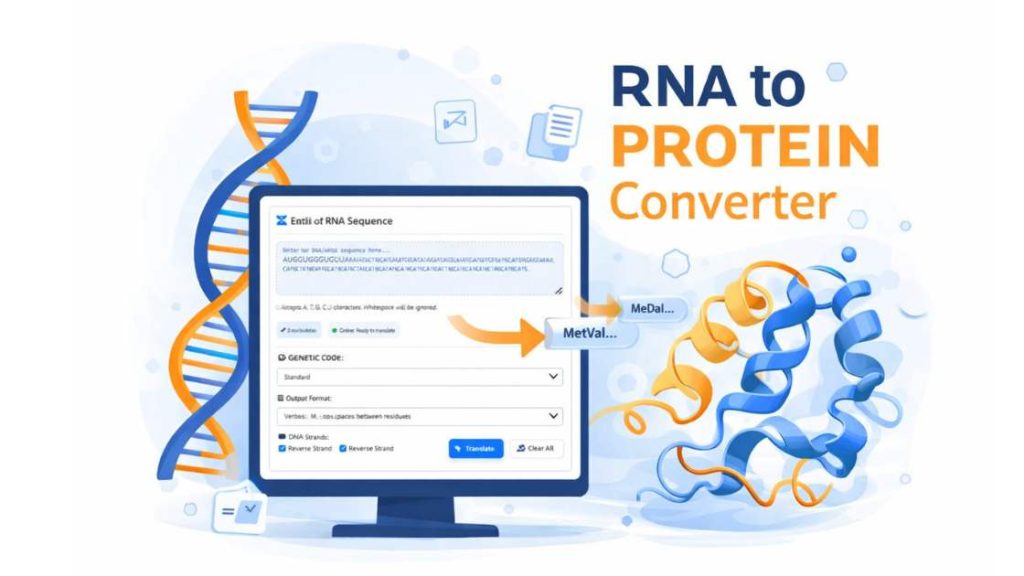
The RNA to Protein Converter quickly turns DNA or RNA into a protein sequence. It changes sets of three letters (codons) into amino acids using your chosen code. You can search all six possible reading frames and download results in different styles. The tool marks start and stop points, handles unclear letters, and gives easy-to-understand output for your next steps.
How to use
- Enter your sequence: Paste your DNA or RNA sequence into the Enter DNA/RNA Sequence text area. The tool accepts the characters A, T, G, C, and U; all whitespace is automatically ignored.
- Check input status: Below the input box, the interface shows the total number of nucleotides and an online status indicator confirming that the sequence is ready for translation.
- Select genetic code: In the Translation Options section, choose the appropriate Genetic Code (for example, Standard). This determines how codons are mapped to amino acids.
- Choose output format: Use the Output Format dropdown to control how the protein sequence is displayed. Available options include compact one-letter output or more descriptive formats with stop codon markers.
- If your input sequence is DNA, you can choose to translate the Forward Strand, the Reverse Strand, or both strands. Choosing both translates the sequence in all reading frames across both strands.
- Translate: Click the Translate button to generate the amino acid sequence(s). Results appear immediately in the output panel.
Features
- Multiple genetic codes: Standard, Vertebrate Mitochondrial, Bacterial/Plant Plastid, and other common codon tables.
- Six-frame translation: Translate in all six reading frames (three on the forward strand and three on the reverse complement) and present results side by side for easy comparison.
- Input flexibility: Accepts raw mRNA/DNA text, single- or multi-record FASTA files, and plain-text uploads.
- ORF detection and filtering: Optionally return only ORFs above a user-defined amino-acid length.
- Ambiguous base support: Recognizes IUPAC nucleotide codes (R, Y, S, W, K, M, B, D, H, V, N) and offers configurable handling (report as X or enumerate all possible amino acids).
- Clear codon/translation report: For verbose output, the converter annotates codon boundaries and presents residue names in three-letter or one-letter format, with explicit Stop tokens where termination codons occur.
Logic of the application
- Preprocessing: The input sequence is sanitized (whitespace removed and uppercase normalized). If the input is labeled as DNA, thymine (T) is used; if mRNA, uracil (U) is expected. The tool supports both conventions and will automatically detect if the input includes both U and T.
- Frame selection & reverse complement: For multi-frame translations, the forward strand is translated for frames 1 to 3. The reverse complement is computed, and frames 4 to 6 correspond to -1 to -3 relative to the original input.
- Codon mapping: Each triplet is matched to an amino acid using the chosen codon table. The application implements the standard and common variant genetic codes and applies them deterministically.
- Ambiguity handling: If a codon contains ambiguous bases (IUPAC codes), the application either returns X (unknown residue) or computes all possible amino acids that codon could encode and reports the ambiguity as selected. handling: Stop codons are represented explicitly (Stop in verbose mode, – or * in compact modes, depending on user preference). When ORF filtering is enabled, only sequences bounded by start and stop codons (or meeting the minimum length criteria) are shown.
- Output formatting: The amino-acid sequence is formatted according to the selected output mode (verbose, compact, include nucleotide sequence, etc.) and prepared for display and download.
Output examples
Input (mrna)
auggccuuuggacuauga
Verbose output
Met Gly Leu Trp Asp Stop
Compact output
MGLWD-
Include nucleotide sequence (compact)
aug gcc uuu gga cua uga -> M G L W D –
Applications
- Molecular cloning & design: Quickly confirm the translated amino-acid sequence of a designed mrna or DNA insert before ordering or cloning.
- ORF discovery: Identify open reading frames across all six frames to locate potential coding sequences in unannotated transcripts or genomic fragments.
- Sequence verification: Validate predicted proteins from transcriptome assemblies or sequencing reads.
- Education & teaching: Demonstrate codon translation, the effects of frameshifts, and differences between genetic codes in a classroom setting.
- Synthetic biology & protein engineering: Rapidly check codon-to-residue mappings when designing synthetic constructs.
Privacy & data handling
Your privacy and data security are priorities. Uploaded files and pasted sequences are used solely for translation. Files are removed from the server immediately after processing; no long-term storage or indexing is performed. If you have concerns or require a different retention policy for institutional workflows, please contact us.