Molecular File Converter
Convert between chemical file formats with our web-based tool

Was this tool helpful?
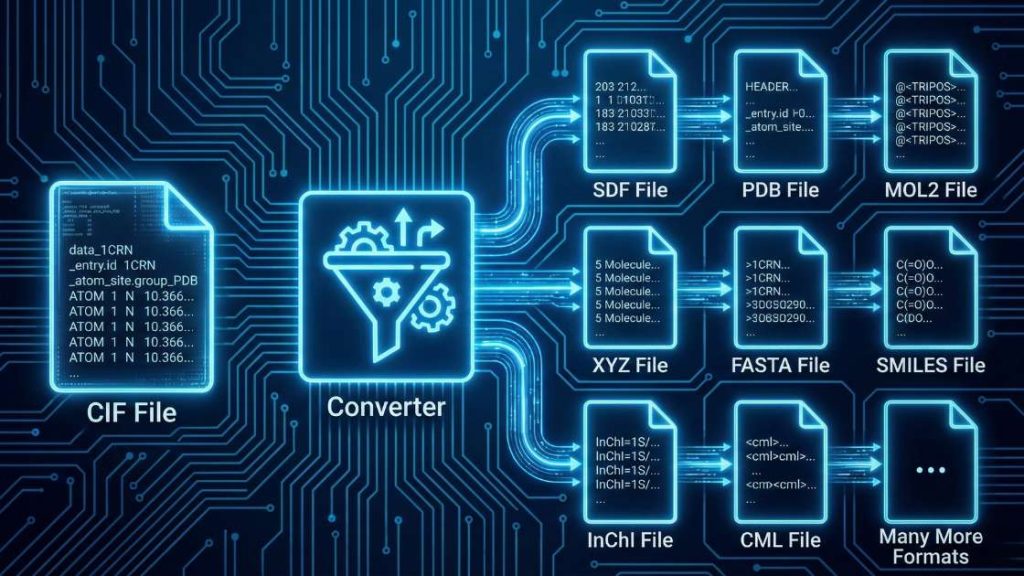
Our CIF File Converter is a powerful web-based utility designed to translate detailed crystallographic data into widely compatible formats for molecular modeling and visualization. The tool effortlessly converts Crystallographic Information Files (CIF or mmCIF) into popular chemical formats such as PDB, MOL2, or SDF. During conversion, it accurately extracts essential information—including atomic coordinates, molecular connectivity, and unit cell parameters—while intelligently resolving or simplifying crystallographic symmetry data. This transformation is crucial for preparing structures for advanced computational workflows such as molecular docking, molecular dynamics simulations, or quantum mechanics calculations, ensuring that your data is fully optimized for any analysis pipeline.
| Input Format | Data Type | Possible Output Formats |
|---|---|---|
| cif, mmcif | Crystallographic / Molecular Structure | adf, adfout, alc, arc, bgf, box, bs, c3d1, c3d2, cac, caccrt, cache, car, ccc, cdx, cerius, cht, cml, com, CONFIG, CONTCAR, contcar, crk2d, crk3d, csr, cssr, ct, cub, cube, dmol, ent, fa, fasta, fch, fchk, fck, feat, fh, fix, fpt, fra, gam, gamess, gamin, gau, gc, gcg, gjc, gjf, gpr, gr96, gro, gukin, gukout, gzmat, hin, inp, ins, int, jin, jout, mdl, mmd, mmod, mol, mol2, molden, moo, mop, mopcrt, mopout, mpc, Mv, Mz, nw, nwo, out, outmol, pc, pcm, pdb, pdbqt, png, POSCAR, poscar, pov, pqr, pqs, prep, qcin, qcout, report, res, rs, sdf, sd, smi, sy2, t, tdd, therm, tmol, txt, un, VASP, vasp, vibe, wln, xsf, xyz |
How to use (step-by-step)
Follow these simple steps to convert your CIF file in seconds.
- Upload Your File: Click “Upload File” or drag and drop your
ciffile directly into the designated area. You can also paste the file’s content using the “Paste Data” option. - Choose Your Output Format: Use the “Output Format” dropdown menu to select your desired format, such as
pdb,mol2, orxyz. The input format will be automatically detected. - Start the Conversion: Press the “Convert File” button to begin the process. The tool will process your file instantly.
- Download Your File: Once the conversion is complete, a download link for your new file will appear. Click it to save the file to your device.

Tip: If you see an error during conversion, check the Troubleshooting Guide below—common causes and fixes are listed.
Understanding the Conversion Process
Converting your cif file involves a significant structural and syntactical transformation. Here’s a breakdown of the input format, the common output formats you can choose, and the core changes that happen during the conversion.
The Input: CIF Format
The Crystallographic Information File (cif) is the standard text-based format for storing crystal structure information, maintained by the International Union of Crystallography (IUCr). It uses a system of data blocks (starting with data_...) and key-value pairs (e.g., _cell_length_a, _atom_site_fract_x) to define the unit cell parameters, space group symmetry, and atomic positions in fractional coordinates.
Example cif file:
data_benzene
_symmetry_space_group_name_H-M   'P b c a'
_cell_length_a   7.460
_cell_length_b   9.666
_cell_length_c   7.034
_cell_angle_alpha   90.00
_cell_angle_beta    90.00
_cell_angle_gamma   90.00
loop_
  _atom_site_label
  _atom_site_fract_x
  _atom_site_fract_y
  _atom_site_fract_z
   C1 0.0496  0.1412  0.1509
   C2 -0.0906 0.0468  0.1517
   ...
Common Output Formats & Their Uses
Your choice of output format depends on the software or analysis you plan to use next.

- pdb (Protein Data Bank) Format: A widely used format for storing 3D coordinates of macromolecules. It is compatible with nearly all molecular visualization and simulation software.
- Best for: Visualizing structures in PyMOL, VMD, or UCSF Chimera; preparing systems for molecular dynamics simulations with GROMACS or AMBER.
- mol2 (Tripos) Format: A versatile format that includes 3D coordinates, atom types, and partial charge information, commonly used in drug discovery and computational chemistry.
- Best for: Preparing small molecules (ligands) for molecular docking studies with programs like AutoDock, DOCK, or GOLD.
- sdf (Structure-Data File) Format: An extension of the
molformat that can store data for multiple molecules in a single file, along with associated data fields.- Best for: Creating chemical libraries, managing datasets for cheminformatics analyses, and use in software like KNIME or Pipeline Pilot.
- xyz Format: A simple, plain-text format that lists the number of atoms, a comment line, and the element symbol with its Cartesian (X, Y, Z) coordinates for each atom.
- Best for: Quick visualization, input for some quantum chemistry programs, and easy parsing with custom scripts.
The Core Transformation Process
Regardless of the output you select, the converter performs these fundamental steps:
- Parses Crystallographic Data: It reads the
ciffile to extract the unit cell dimensions, space group symmetry operators, and the fractional coordinates of each atom in the asymmetric unit. - Reconstructs the Structure: It applies the necessary symmetry operations to generate the atoms for the complete molecule or unit cell and converts the fractional atomic positions into standard Cartesian coordinates.
- Perceives Molecular Connectivity: It automatically calculates and assigns bonds between atoms based on standard covalent radii and interatomic distances, building a complete topological representation.
- Applies New Formatting Rules: It rebuilds the file according to the strict syntax of your chosen output format—whether that means creating
ATOMrecords forpdb, defining a connection table formol2andsdf, or listing simple coordinates forxyz.
Compatible Software
The generated output files can be used with hundreds of scientific tools. The ideal software depends on your chosen format:
- pdb files: PyMOL, UCSF Chimera, VMD, GROMACS, AMBER, NAMD.
- mol2/sdf files: AutoDock Tools, DOCK, GOLD, Schrödinger Suite, MOE, Discovery Studio.
- xyz files: Avogadro, Jmol, VESTA, and many quantum chemistry packages.
Troubleshooting Guide
Encountering an error can be frustrating, but most issues are easy to fix. Here are the most common problems you might face and how to resolve them.
General Tool Errors
Error: “File size exceeds the limit”
- Why it happens: Your uploaded file is larger than the maximum allowed size. Our server has this limit to ensure quick processing for all users.
- How to fix: If your
ciffile is exceptionally large due to a complex structure, ensure it contains only the necessary data. For processing larger files or to inquire about unlimited usage, please contact us for custom solutions.
Error: “Processing timed out”
- Why it happens: The conversion for your molecule is taking too long, which can happen with extremely large unit cells or highly disordered structures.
- How to fix: Try to simplify your input file if possible. If the issue persists because your structure is inherently complex, please contact us to discuss options for handling larger computations.
Error: “CAPTCHA validation failed”
- Why it happens: Our system uses a CAPTCHA to prevent automated bots. This error occurs if the CAPTCHA was not solved correctly or timed out.
- How to fix: Simply reload the page and solve the new CAPTCHA. If you continue to have trouble after reloading, please get in touch with our support team.
Conversion-Specific Errors
These errors typically relate to the scientific data within your cif file.
Error: “Failed to perceive bonds” or “Incorrect molecular connectivity”
- Why it happens: The
ciffile may not contain explicit bond information (_geom_bond_*records). The tool attempts to infer bonds based on atomic distances, but this can fail for structures with unusual bond lengths, coordination complexes, or densely packed atoms. - How to fix: Before uploading, use a crystallographic viewer like VESTA or Mercury to check the structure and, if possible, save it to a format with explicit connectivity. Alternatively, you may need to manually edit the output file to correct the bonding.
Error: “Incomplete structure or missing atoms in output”
- Why it happens: The conversion may have only processed the asymmetric unit without correctly applying all symmetry operations needed to generate the full, biologically relevant molecule or a complete unit cell.
- How to fix: Ensure your
ciffile contains the correct and complete space group and unit cell information. Using software like Mercury to generate the full structure and exporting it as a new file can often resolve this before conversion.
Error: “Unrecognized atom type or element”
- Why it happens: Your
ciffile contains non-standard element symbols or atom labels in the_atom_site_type_symbolor_atom_site_labelfields that the conversion engine’s chemical dictionary does not recognize. - How to fix: Open the
ciffile in a text editor and carefully check these columns. Correct any typos or non-standard names to conform to official IUPAC element symbols (e.g., change “Va” to “V” for Vanadium).
If your problem isn’t listed here, we want to know about it! Please help us improve the tool by reporting the issue.
Support Our Work
We are committed to keeping our scientific tools free and accessible for everyone. If this tool has been helpful in your work, please consider supporting our mission with a donation. Your support directly helps us cover server costs and fund the development of new, powerful tools for the scientific community.
FAQ
References & Suggested Reading
This tool was developed in line with established principles in crystallography and computational chemistry for accurate, reliable results. The resources listed below are foundational research and key papers that define these standards, and we highly recommend them for a deeper understanding of the scientific principles involved.
- Hall, S. R., Allen, F. H., & Brown, I. D. (1991). The Crystallographic Information File (CIF): a new standard archive file for crystallography. Acta Crystallographica Section A: Foundations of Crystallography, 47(6), 655–685. https://doi.org/10.1107/S010876739100640X
- Berman, H. M., Westbrook, J., Feng, Z., Gilliland, G., Bhat, T. N., Weissig, H., Shindyalov, I. N., & Bourne, P. E. (2000). The Protein Data Bank. Nucleic Acids Research, 28(1), 235–242. https://doi.org/10.1093/nar/28.1.235
- O’Boyle, N. M., Banck, M., James, C. A., Morley, C., Vandermeersch, T., & Hutchison, G. R. (2011). Open Babel: An open chemical toolbox. Journal of Cheminformatics, 3(1), 33. https://doi.org/10.1186/1758-2946-3-33
- Humphrey, W., Dalke, A., & Schulten, K. (1996). VMD: Visual molecular dynamics. Journal of Molecular Graphics, 14(1), 33–38. https://doi.org/10.1016/0263-7855(96)00018-5
- Pettersen, E. F., Goddard, T. D., Huang, C. C., Couch, G. S., Greenblatt, D. M., Meng, E. C., & Ferrin, T. E. (2004). UCSF Chimera—A visualization system for exploratory research and analysis. Journal of Computational Chemistry, 25(13), 1605–1612. https://doi.org/10.1002/jcc.20084
Meet the Authors

Mahdi Morshedi Yekta
Founder & Bioinformatics Developer
Mahdi is the founder of ScienceCodons and a Medical Biotechnologist with a deep passion for computational biology. Holding an M.Sc. in Medical Biotechnology, he specializes in transforming complex biological algorithms into accessible, high-performance web tools, bridging the gap between laboratory sciences and software engineering.

Fatemeh Faryadras
Medical Biotechnologist & Researcher
Fatemeh is a Medical Biotechnologist and researcher. With extensive expertise in genetic engineering, molecular cloning, and cancer biology, she combines her rigorous laboratory background with intuitive design principles to create reliable, user-centered scientific calculators and tools.

Dr. Mosayeb Rostamian
Assistant Professor, Infectious Diseases Research Center
Certified Scientific Reviewer
Google ScholarExpert Review Process
To ensure the highest quality and scientific accuracy, this tool's underlying algorithms, formulas, and edge-case handling have been thoroughly reviewed and validated by Dr. Mosayeb Rostamian.
The "Reviewed By" badge signifies that an independent expert has evaluated the tool's logic to guarantee accuracy and alignment with the current consensus in the scientific community.