Translate DNA/mRNA sequences into protein sequences across various genetic codes.
Enter DNA/RNA Sequence
Accepts A, T, G, C, U characters. Whitespace will be ignored.
Translation Options
Was this tool helpful?

The mRNA to Amino Acid Converter is a precise bioinformatics tool designed to translate genetic codes (mRNA or DNA) into protein sequences. Accurate conversion of nucleotide sequences into amino acid chains is essential for gene analysis, mutation research, and protein engineering. This tool facilitates these processes by providing a translation engine that supports multiple reading frames and alternative genetic codes.
How to Use the Tool: A Step-by-Step Guide
- Paste Your Sequence: Enter your mRNA (A, U, G, C) or DNA (A, T, G, C) sequence into the main input area.
- Select Parameters: Choose the appropriate genetic code and the desired reading frame.
- Choose Output Style: Select whether to display the full alignment or only the resulting protein sequence.
- Translate: Click the “Translate” button to view results instantly below. Identify Start (Met) and Stop codons highlighted for easy reference.
Technical Logic & Translation Mechanics
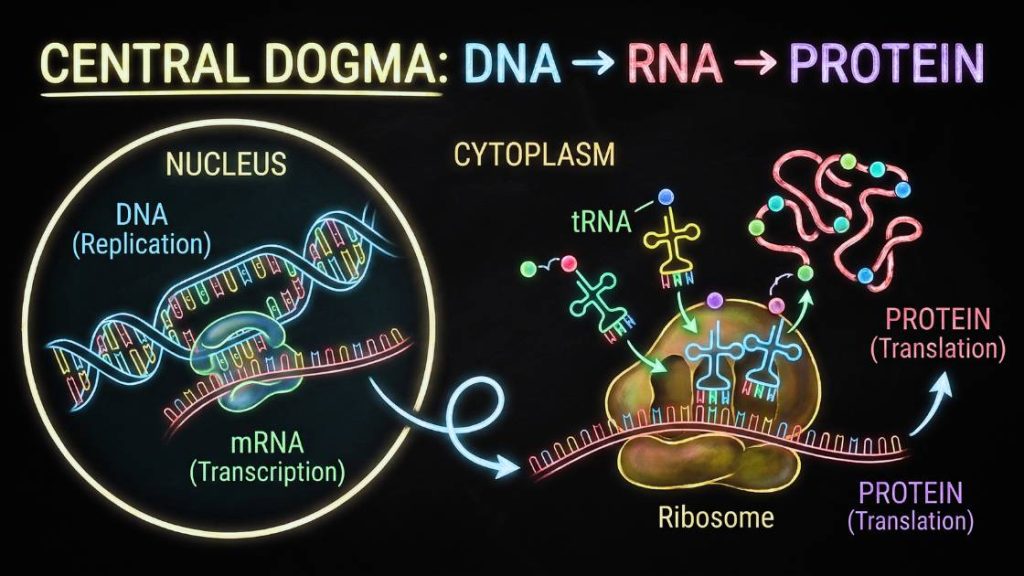
Translation is the process by which ribosomes read mRNA to synthesize amino acid chains. Our algorithm identifies codons, or nucleotide triplets, each corresponding to one of the 20 standard amino acids. By integrating standard IUPAC nomenclature and NCBI genetic code tables, the tool ensures that “In Silico” translation matches biological reality. The logic is divided into the following stages:
- Input Sanitation: The system first removes non-nucleotide characters (numbers, whitespace, and special characters). It then converts all ‘T’s to ‘U’s when a DNA sequence is provided, simulating the transcription step before translation.
- Frame Identification: In biological systems, translation can begin at different nucleotide positions. Our engine shifts the starting index based on the user’s selection (Forward Frames 1, 2, or 3) to analyze all potential Open Reading Frames (ORFs).
- Codon Fragmentation: The string is partitioned into discrete triplets (3-letter chunks). This mimics how the ribosome moves along the mRNA strand, one codon at a time.
- Dictionary Mapping: Each triplet is compared against a hash map of the genetic code. If a codon is incomplete (less than three bases at the end), it is ignored or marked as a partial sequence, reflecting the physical limitations of ribosomal binding.
- Termination Logic: The process continues until a Stop Codon (UAA, UAG, or UGA) is encountered, signaling the release of the polypeptide chain or the end of the sequence.
Example:
- Input mRNA: 5′- AUG GCA UUC GAG UAG -3′
- Step 1 (Codon 1): AUG → Maps to Methionine (M) [Start Codon]
- Step 2 (Codon 2): GCA → Maps to Alanine (A)
- Step 3 (Codon 3): UUC → Maps to Phenylalanine (F)
- Step 4 (Codon 4): GAG → Maps to Glutamic Acid (E)
- Step 5 (Codon 5): UAG → Maps to Stop (*)
- Final Output (1-Letter): MAFE*
- Final Output (3-Letter): Met-Ala-Phe-Glu-Stop
Features
1. Multi-Frame Translation (ORFs)
The tool can analyze all possible Open Reading Frames (ORFs). In biological sequences, translation can start at different positions, leading to different protein products.
2. Standard and Alternative Genetic Codes
While most organisms use the Standard Genetic Code, certain organelles (like mitochondria) or specific taxa use alternative codes. Our converter supports various translation tables to ensure accuracy across different species.
3. Customizable Output Formats
- Verbose Mode: View the amino acid sequence aligned directly under the corresponding codons.
- Compact/FASTA Mode: Generate a pure protein string ready for BLAST searches or sequence alignment tools.
- 1-Letter vs 3-Letter Codes: Choose between standard notations (e.g., M-A-G vs Met-Ala-Gly).
FAQ
Reference
Thieffry, D., & Sarkar, S. (1998). Forty years under the central dogma. Trends in Biochemical Sciences, 23(8), 312–316. https://doi.org/10.1016/s0968-0004(98)01244-4
Bustamante, C., Cheng, W., & Mejia, Y. X. (2011). Revisiting the Central Dogma One Molecule at a Time. Cell, 144(4), 480–497. https://doi.org/10.1016/j.cell.2011.01.033
Meet the Authors

Mahdi Morshedi Yekta
Founder & Bioinformatics Developer
Mahdi is the founder of ScienceCodons and a Medical Biotechnologist with a deep passion for computational biology. Holding an M.Sc. in Medical Biotechnology, he specializes in transforming complex biological algorithms into accessible, high-performance web tools, bridging the gap between laboratory sciences and software engineering.

Fatemeh Faryadras
Medical Biotechnologist & Researcher
Fatemeh is a Medical Biotechnologist and researcher. With extensive expertise in genetic engineering, molecular cloning, and cancer biology, she combines her rigorous laboratory background with intuitive design principles to create reliable, user-centered scientific calculators and tools.

Dr. Mosayeb Rostamian
Assistant Professor, Infectious Diseases Research Center
Certified Scientific Reviewer
Google ScholarExpert Review Process
To ensure the highest quality and scientific accuracy, this tool's underlying algorithms, formulas, and edge-case handling have been thoroughly reviewed and validated by Dr. Mosayeb Rostamian.
The "Reviewed By" badge signifies that an independent expert has evaluated the tool's logic to guarantee accuracy and alignment with the current consensus in the scientific community.