Molecular File Converter
Convert between chemical file formats with our web-based tool

Was this tool helpful?
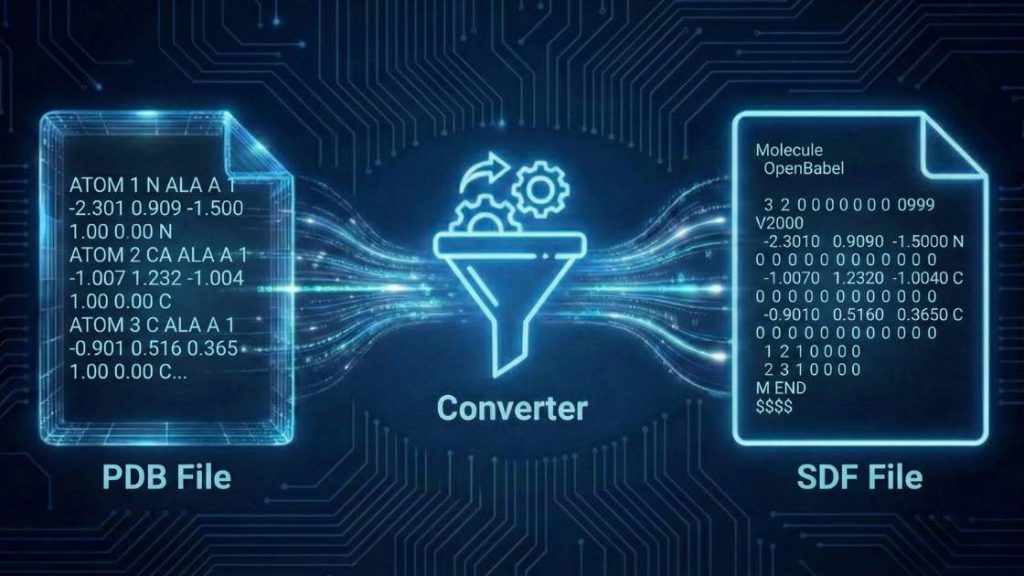
Our PDB to SDF Converter is an easy-to-use, web-based tool designed to convert protein and ligand files from the Protein Data Bank (PDB) format to the Structure Data File (SDF) format. The conversion process is essential for preparing molecular data for use in cheminformatics and molecular modeling. This tool ensures that the necessary structural and chemical information is preserved and formatted correctly, making it ready for applications such as molecular docking, structure-activity relationship (SAR) analysis, and virtual screening.
How to Use: Simple Steps to Get Started
- Choose Your Formats: Use the “Input Format” and “Output Format” dropdown menus to select the conversion you need. Ensure that Protein Data Bank (PDB) is selected as the input and Structure Data File (SDF) is selected as the output.
- Upload Your File: Click “Upload File” or drag and drop your file directly into the designated area. You can also paste the file’s content using the “Paste Content” option.
- Start the Conversion: Press the “Convert File” button to begin the process. The tool will process your file instantly.
- Download: Once the conversion is complete, a download link for your new file will appear. Click it to save the file to your device.
The Conversion Logic

The conversion starts by reading 3D atomic positions from your PDB file. Because PDB files may not show all bonds, the tool uses atom-to-atom distances to predict which atoms are bonded.
Once the connectivity is established, the logic proceeds to Bond Order Perception. The tool analyzes each atom’s hybridization state and valence requirements to assign explicit single, double, or triple bonds. This step is critical because the SDF format requires a formal “Bond Block” to define the molecule’s topology, which is a key change from the coordinate-heavy PDB format.
Furthermore, the converter handles Metadata Mapping and Standardization. Supplementary residue data or identifiers from the PDB records are mapped into SDF data headers (annotated with < > tags). Finally, the atomic coordinates are reformatted to meet the strict precision requirements of the MDL-style SDF specification, ensuring compatibility with rigorous chemical informatics pipelines.
Sample input (.pdb)
If you upload a pdb file containing content like the example below:
HETATM    1  C1  ETH A   1       0.000   0.000   0.000  1.00  0.00           C
HETATM    2  C2  ETH A   1       1.540   0.000   0.000  1.00  0.00           C
HETATM    3  O   ETH A   1       2.140   1.200   0.000  1.00  0.00           O
HETATM    4  H1  ETH A   1      -0.540   0.900   0.000  1.00  0.00           H
HETATM    5  H2  ETH A   1      -0.540  -0.900   0.000  1.00  0.00           H
CONECT    1    2    4    5
CONECT    2    1    3
Sample Output (.sdf)
…the resulting sdf output will be written as a Molfile/SDF record with an atom block (coordinates + elements) and a bond block (connectivity), for example:
ETH
  Converted by PDB to SDF Converter

  5  4  0  0  0  0  0  0  0  0  999 V2000
    0.0000    0.0000    0.0000 C   0  0  0  0  0  0  0  0  0  0  0  0
    1.5400    0.0000    0.0000 C   0  0  0  0  0  0  0  0  0  0  0  0
    2.1400    1.2000    0.0000 O   0  0  0  0  0  0  0  0  0  0  0  0
   -0.5400    0.9000    0.0000 H   0  0  0  0  0  0  0  0  0  0  0  0
   -0.5400   -0.9000    0.0000 H   0  0  0  0  0  0  0  0  0  0  0  0
  1  2  1  0  0  0  0
  1  4  1  0  0  0  0
  1  5  1  0  0  0  0
  2  3  1  0  0  0  0
M  END
> <SOURCE_FORMAT>
pdb

> <PDB_RESNAME>
ETH

$$$$
Support Our Work
We aim to offer high-quality, free scientific tools for researchers. Operating these servers and updating our tools requires significant resources. If our PDB to SDF Converter has helped your research or made your work easier, please think about supporting us. Your help lets us keep these tools available to scientists and students everywhere.
References
- O’Boyle, N.M., Banck, M., James, C.A. et al. Open Babel: An open chemical toolbox. J Cheminform 3, 33 (2011). https://doi.org/10.1186/1758-2946-3-33
- Carrillo, Melissa, Suraj Pandey, Juan Sanchez, et al. 2021. “High-Resolution Crystal Structures of Transient Intermediates in the Phytochrome Photocycle.” Structure 29 (7): 743-754.e4. https://doi.org/10.1016/j.str.2021.03.004.
Meet the Authors

Mahdi Morshedi Yekta
Founder & Bioinformatics Developer
Mahdi is the founder of ScienceCodons and a Medical Biotechnologist with a deep passion for computational biology. Holding an M.Sc. in Medical Biotechnology, he specializes in transforming complex biological algorithms into accessible, high-performance web tools, bridging the gap between laboratory sciences and software engineering.

Fatemeh Faryadras
Medical Biotechnologist & Researcher
Fatemeh is a Medical Biotechnologist and researcher. With extensive expertise in genetic engineering, molecular cloning, and cancer biology, she combines her rigorous laboratory background with intuitive design principles to create reliable, user-centered scientific calculators and tools.

Dr. Mosayeb Rostamian
Assistant Professor, Infectious Diseases Research Center
Certified Scientific Reviewer
Google ScholarExpert Review Process
To ensure the highest quality and scientific accuracy, this tool's underlying algorithms, formulas, and edge-case handling have been thoroughly reviewed and validated by Dr. Mosayeb Rostamian.
The "Reviewed By" badge signifies that an independent expert has evaluated the tool's logic to guarantee accuracy and alignment with the current consensus in the scientific community.