
GRAVY Index Score Calculator
Analyze biochemical and physical parameters of your protein sequences
Input Protein Sequence
Only standard amino acid characters are accepted.
Was this tool helpful?
Our GRAVY Index Calculator is a comprehensive, web-based tool designed to calculate the essential biochemical and physical properties of your protein sequences. By simply inputting a sequence, you can instantly generate a detailed analysis, including the Grand Average of Hydropathicity (GRAVY) index, molecular weight, theoretical pI, and amino acid composition. This tool helps you quickly characterize proteins, predict their behavior in various biochemical assays, and gain critical insights for downstream applications like protein purification, electrophoresis, and structural analysis.
How to Use
Analyzing your protein sequence is a simple, three-step process:
- Input Sequence: Paste your protein sequence into the provided text box. The tool accepts standard, single-letter amino acid characters.
- Analyze: Click the blue “Analyze Sequence” button to process your data.
- View Results: The tool will immediately display a comprehensive report of the calculated physicochemical parameters for your protein. You can use the “Clear All” button to reset the input field for a new analysis.
Tip: Ensure your input sequence contains only the 20 standard one-letter amino acid codes. Any non-standard characters will be ignored during the calculation.
How is GRAVY Index Calculated?
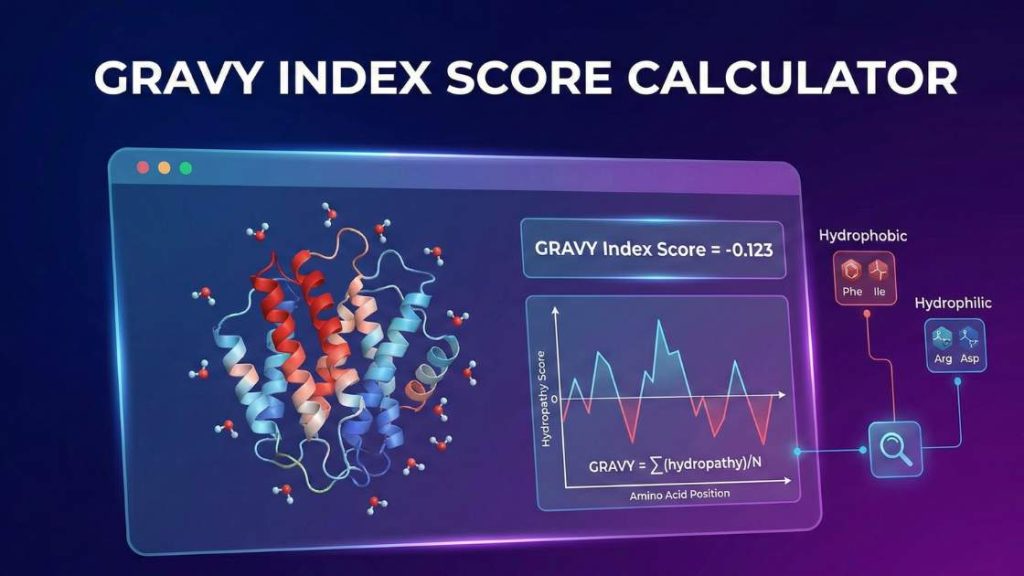
The Grand Average of Hydropathicity (GRAVY) index is a key indicator of a protein’s overall hydrophobicity or hydrophilicity. It is calculated as the sum of the hydropathy values of all the amino acids in the sequence, divided by the total number of residues. Each amino acid is assigned a specific hydropathy value based on established scales, most commonly the Kyte & Doolittle scale.
The formula is as follows:
GRAVY=(∑Hydropathy values of all amino acids)/(Total number of residues)
A positive GRAVY score indicates that the protein is generally hydrophobic, meaning it is more likely to be found in a non-polar environment, such as embedded within a cell membrane. Conversely, a negative score suggests the protein is hydrophilic and more likely to be soluble in aqueous environments.
Features and Outputs
This tool provides the following analyses and outputs for your protein sequence:
- Amino Acid Composition: Provides the absolute count and percentage frequency for each of the 20 standard amino acids.
- Molecular Weight (MW): Calculates the molecular weight of the protein sequence based on the average isotopic masses of the amino acids.
- Theoretical Isoelectric Point (pI): Estimates the pH at which the protein has a net neutral charge, which is crucial for purification and electrophoresis methods.
- Amino Acid Property Groups: Classifies and totals amino acids based on their chemical properties (e.g., Hydrophobic, Polar, Positively Charged, Negatively Charged).
- Atomic Composition: Provides the total count of each type of atom (Carbon, Hydrogen, Nitrogen, Oxygen, Sulfur) that constitutes the protein.
- Extinction Coefficient: Estimates the molar absorption coefficient of the protein at 280 nm, which is useful for determining protein concentration via UV spectroscopy.
- Estimated Half-Life: Offers a prediction of the protein’s stability and lifespan within different biological systems (mammalian, yeast, and E. coli).
- Instability Index: Computes an index to predict the stability of the protein in a test tube. A value below 40 indicates a stable protein.
- Aliphatic Index: Calculates the relative volume of the protein occupied by aliphatic side chains (Alanine, Valine, Isoleucine, and Leucine), which is correlated with thermostability.
- Grand Average of Hydropathicity (GRAVY): A score representing the overall hydrophobicity of the protein. Positive values indicate a hydrophobic nature, while negative values suggest a hydrophilic nature.
Support Our Work
We are committed to keeping our scientific tools free and accessible for everyone. If this tool has been helpful in your work, please consider supporting our mission with a donation. Your support directly helps us cover server costs and fund the development of new, powerful tools for the scientific community. For questions or collaborations, please contact us.
FAQ
References & Suggested Reading
This tool is built on established scientific principles and algorithms to ensure accurate and reliable results. The resources listed below are the foundational research and key papers that define these standards, and we highly recommend them for a deeper understanding of the scientific principles involved.
- Kyte, J., & Doolittle, R. F. (1982). A simple method for displaying the hydropathic character of a protein. Journal of Molecular Biology, 157(1), 105–132. https://doi.org/10.1016/0022-2836(82)90515-0
- Gasteiger, E., Hoogland, C., Gattiker, A., Duvaud, S., Wilkins, M. R., Appel, R. D., & Bairoch, A. (2005). Protein identification and analysis tools on the ExPASy server. In J. M. Walker (Ed.), The Proteomics Protocols Handbook (pp. 571–607). Humana Press. https://doi.org/10.1385/1-59259-890-0:571
- Bjellqvist, B., Hughes, G. J., Pasquali, C., Paquet, N., Rigolet, F., Bairoch, A., & Hochstrasser, D. F. (1993). The focusing positions of proteins in immobilized pH gradients can be predicted from their amino acid sequences. Electrophoresis, 14(1), 1023–1031. https://doi.org/10.1002/elps.11501401163
Meet the Authors

Mahdi Morshedi Yekta
Founder & Bioinformatics Developer
Mahdi is the founder of ScienceCodons and a Medical Biotechnologist with a deep passion for computational biology. Holding an M.Sc. in Medical Biotechnology, he specializes in transforming complex biological algorithms into accessible, high-performance web tools, bridging the gap between laboratory sciences and software engineering.

Fatemeh Faryadras
Medical Biotechnologist & Researcher
Fatemeh is a Medical Biotechnologist and researcher. With extensive expertise in genetic engineering, molecular cloning, and cancer biology, she combines her rigorous laboratory background with intuitive design principles to create reliable, user-centered scientific calculators and tools.

Dr. Mosayeb Rostamian
Assistant Professor, Infectious Diseases Research Center
Certified Scientific Reviewer
Google ScholarExpert Review Process
To ensure the highest quality and scientific accuracy, this tool's underlying algorithms, formulas, and edge-case handling have been thoroughly reviewed and validated by Dr. Mosayeb Rostamian.
The "Reviewed By" badge signifies that an independent expert has evaluated the tool's logic to guarantee accuracy and alignment with the current consensus in the scientific community.