Bioinformatics Converter
Convert between various bioinformatics formats instantly
Paste Data
Upload File
Conversion output will appear here...
Was this tool helpful?
Fasta to GenBank Converter is an online tool for fast, accurate conversion of biological sequences from FASTA to GenBank format. The tool streamlines bioinformatics workflows by allowing you to convert sequence data into a database- and analysis-ready format without installing additional software.

With our converter, you can upload DNA, RNA, or protein sequences and obtain output that is fully compliant with the GenBank format, including descriptive information, basic annotations, and standardized formatting, within seconds. The tool ensures high conversion accuracy and significantly reduces the time required to prepare sequence data for storage, sharing, and downstream analysis.
How to use (step-by-step)
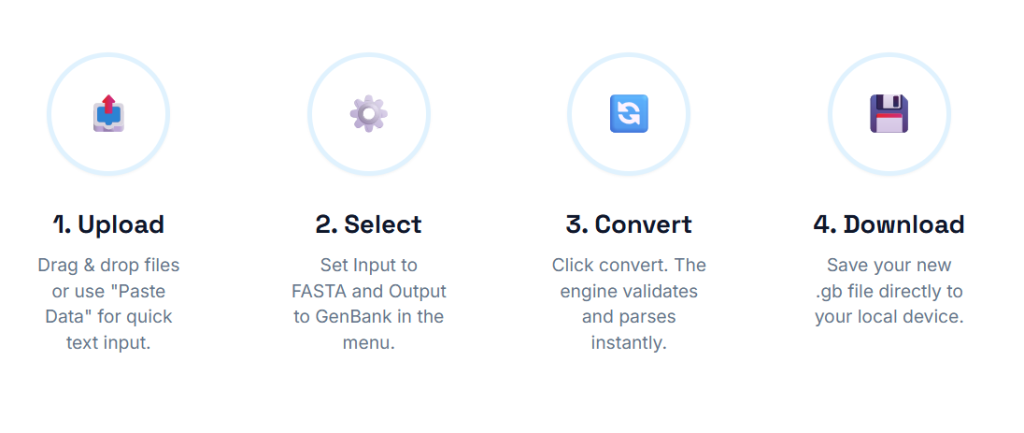
- Upload Your File: Click “Upload File” or drag and drop your file directly into the designated area. You can also paste the file’s content using the “Paste Data” option for quick processing.
- Select Your Formats: Use the dropdown menus to confirm your settings. Ensure that FASTA is selected as your input format and GenBank as your output format.
- Start the Conversion: Press the “Convert File” button to begin the process. The tool will parse your sequence data and generate the corresponding GenBank structure instantly.
- Download: Once the conversion is complete, a download link for your new file will appear. Click it to save the GenBank file to your device.
How the Conversion Works
The conversion process uses sequence-parsing logic to map the FASTA structure, which includes a single-line identifier and raw sequence, into the hierarchical GenBank format. It initializes a sequence record and parses the FASTA header into the ID, Name, and Description fields. Although FASTA lacks metadata, the converter creates the required LOCUS line by calculating sequence length and inferring the molecule type, usually DNA or protein. Specialized bioinformatics objects ensure the output meets NCBI GenBank standards, providing a valid framework for further annotation.
Conversion Example
To visualize how the data is restructured, consider the following example of a standard conversion:
Input (FASTA Format):
>NC_045512.2 SARS-CoV-2, complete genome
ATTAAAGGTTTATACCTTCCCAGGTAACAAACCAACCAACTTTCGATCTCTTGTAGATCT
GTTCTCTAAACGAACTTTAAAATCTGTGTGGCTGTCACTCGGCTGCATGCTTAGTGCACT
Output (GenBank Format):
LOCUS       NC_045512                120 bp    DNA     linear   UNK 01-JAN-2025
DEFINITION  NC_045512.2 SARS-CoV-2, complete genome.
ACCESSION   NC_045512
VERSION     NC_045512.2
KEYWORDS    .
SOURCE      .
  ORGANISM  .
            .
FEATURES             Location/Qualifiers
ORIGIN
        1 attaaaggtt tataccttcc caggtaacaa accaaccaac tttcgatctc ttgtagatct
       61 gttctctaaa cgaactttaa aatctgtgtg gctgtcactc ggctgcatgc ttagtgcact
//
Key Features
- Header Parsing: Automatically extracts identifiers and descriptions from FASTA headers to populate initial GenBank metadata fields.
- Structure Validation: Validates the sequence against standard biological alphabets to ensure compatibility with downstream bioinformatics pipelines.
- Multi-Record Support: Efficiently processes multi-FASTA files, generating a single GenBank file containing multiple records (concatenated format).
- Viewer Compatibility: Produces standardized outputs compatible with industry-leading software such as SnapGene, Geneious, and various NCBI command-line tools.
Common Conversion Errors and Troubleshooting
- Invalid IUPAC Characters: If the sequence contains numerical values, spaces, or non-standard characters (e.g., characters outside the A, C, G, T/U or amino acid range), the engine will be unable to finalize the record.
- Malformed Header Lines: Every sequence record must begin with a
>character. Missing or duplicate header lines, or headers containing illegal characters, may result in a parsing error. - Missing Sequence Data: A record containing only a header without an associated sequence is considered an invalid entry and will be skipped or cause a terminal error.
- Undefined Molecule Type: GenBank files require a specific molecule type. If the converter cannot infer whether the sequence is DNA, RNA, or Protein from your selection, the conversion may fail.
Support Our Work
We are dedicated to providing free, high-quality computational tools to researchers, students, and the global bioinformatics community. Maintaining these resources and developing new features requires significant time and infrastructure costs. If our Fasta to GenBank Converter has assisted your research or simplified your workflow, please consider supporting our mission. Your contributions help us keep these tools accessible and free for everyone.
Donate us: Support our mission and development
References
Cock, P. J. A., Antao, T., Chang, J. T., Chapman, B. A., Cox, C. J., Dalke, A., Friedberg, I., Hamelryck, T., Kauff, F., Wilczynski, B., & de Hoon, M. J. L. (2009). Biopython: freely available Python tools for computational molecular biology and bioinformatics. Bioinformatics, 25(11), 1422–1423.