Reverse Translate
A modern bioinformatics tool to generate a likely DNA coding sequence from a protein sequence using a specified codon usage table.
Protein Sequence
Codon Usage Table
Was this tool helpful?
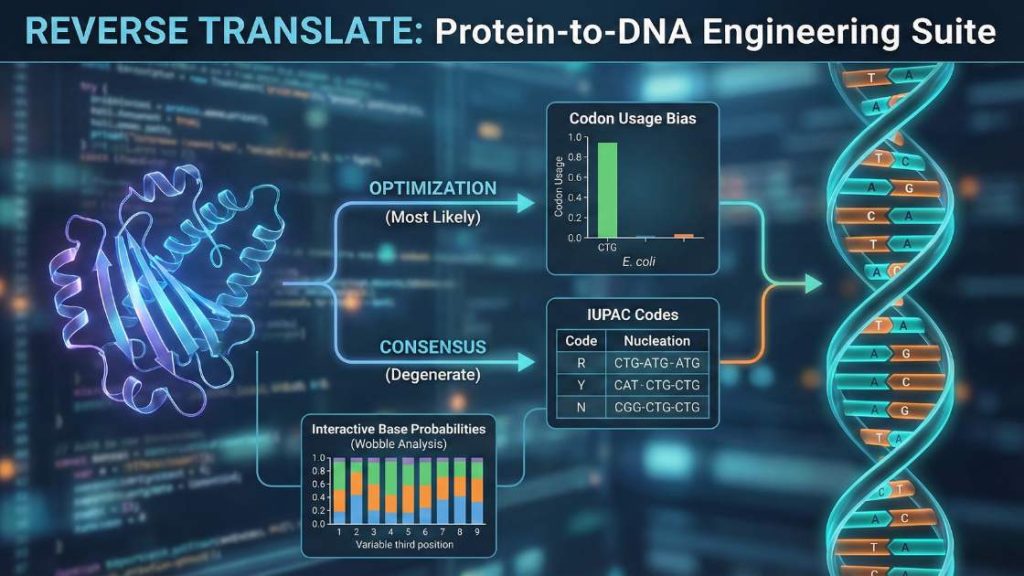
The Reverse Translate tool is a professional bioinformatics application designed to back-translate protein sequences into optimized nucleotide sequences. While the natural biological flow (Central Dogma) moves from DNA to Protein, researchers often need to work in reverse to design genes based on known amino acid sequences. This tool integrates Organism-Specific Codon Usage Tables and IUPAC Degeneracy Logic to solve the complexity of the genetic code, providing high-precision DNA sequences for synthetic biology and molecular cloning.
What is Reverse Translation?
Reverse Translation is the process of predicting the DNA sequence that could encode a specific protein. In nature, translation is a one-way street: DNA is transcribed into mRNA, and mRNA is translated into a protein. However, in biotechnology, we often “reverse” this path.
The primary challenge in reverse translation is that the genetic code is degenerate (redundant). There are 20 standard amino acids, but 64 possible codons. This means:
- Most amino acids are encoded by more than one codon (e.g., Leucine has 6 different codons).
- Going from Protein back to DNA is not a 1-to-1 mapping; there are millions of possible DNA combinations for a single protein.
IUPAC Reference Table for Degeneracy
When generating a Consensus Sequence, we use standard IUPAC codes to represent multiple possible nucleotides at a single position. This is essential for designing degenerate primers.
| A, T, C, G | A, T, C, G | Single Nucleotides |
| R | A or G | puRine |
| Y | C or T | pYrimidine |
| S | G or C | Strong interaction |
| W | A or T | Weak interaction |
| K | G or T | Keto |
| M | A or C | aMino |
| B | C, G or T | Not A |
| D | A, G or T | Not C |
| H | A, C or T | Not G |
| V | A, C or G | Not T |
| N | A, C, G or T | Any nucleotide |
Key Features
1. Dual-Sequence Output
To cater to different research needs, the tool generates two distinct types of DNA sequences:
- Most Likely Codons (Optimized): This sequence is constructed by selecting the codon with the highest frequency in the target organism for each amino acid.
- Primary Use: High-efficiency gene synthesis and heterologous protein expression.
- Consensus Codons (Degenerate): Utilizing the IUPAC codes shown above, this output represents all possible synonymous codons at once.
- Primary Use: Designing degenerate PCR primers and identifying conserved regions.
2. Interactive Base Probabilities Graph
Our unique visualization engine breaks down the statistical bias of the genetic code. By clicking on any amino acid button, users can view a detailed bar chart showing:
- Nucleotide Distribution: The exact probability of A, T, C, and G at each of the three codon positions.
- Wobble Position Analysis: Clear visualization of the 3rd-base bias, which is often the most degenerate position.
How it Works
To ensure the highest accuracy in translation and optimization, please follow these steps in order:
- Input Sequence: Paste your protein sequence in the text area or upload a file (FASTA format supported).
- Select & Configure: Use the Auto Fetch feature to search for your target species (e.g., Escherichia coli) and select the appropriate Genetic Code.
- Fetch Data (Crucial Step): After selecting your parameters, click the Fetch Table button. Our tool will retrieve the specific codon usage data required.
- Process: Once the data is successfully fetched, click the Process button to generate sequences and graphs.
- Export: Use the one-click Copy buttons to transfer your results.
Meet the Authors

Mahdi Morshedi Yekta
Founder & Bioinformatics Developer
Mahdi is the founder of ScienceCodons and a Medical Biotechnologist with a deep passion for computational biology. Holding an M.Sc. in Medical Biotechnology, he specializes in transforming complex biological algorithms into accessible, high-performance web tools, bridging the gap between laboratory sciences and software engineering.

Fatemeh Faryadras
Medical Biotechnologist & Researcher
Fatemeh is a Medical Biotechnologist and researcher. With extensive expertise in genetic engineering, molecular cloning, and cancer biology, she combines her rigorous laboratory background with intuitive design principles to create reliable, user-centered scientific calculators and tools.

Dr. Mosayeb Rostamian
Assistant Professor, Infectious Diseases Research Center
Certified Scientific Reviewer
Google ScholarExpert Review Process
To ensure the highest quality and scientific accuracy, this tool's underlying algorithms, formulas, and edge-case handling have been thoroughly reviewed and validated by Dr. Mosayeb Rostamian.
The "Reviewed By" badge signifies that an independent expert has evaluated the tool's logic to guarantee accuracy and alignment with the current consensus in the scientific community.