Palindromic Sequence Finder
Identify palindromic DNA sequences
DNA Sequence Input
Palindromic Seq Length
| Position | Sequence | Length | Visualization (5′ -> 3′) |
|---|
Was this tool helpful?
In high-throughput genomics, structural analysis of nucleotide sequences remains a cornerstone of molecular biology. Among sequence motifs, palindromes play a pivotal role in genomic stability, gene regulation, and site-specific DNA modifications. Identifying these inverted repeats is essential for researchers studying restriction enzyme kinetics, transcription factor binding sites, and the formation of secondary structures, such as hairpins.

Palindra is a high-performance web-based solution engineered to identify palindromic DNA sequences. The platform processes large genomic datasets rapidly while maintaining a streamlined, user-friendly experience for scientists and bioinformaticians.
How to Use
- DNA Sequence Input: Paste your DNA sequence into the designated text area or drop a sequence file directly into the box. The system supports both raw sequences and standard FASTA formats.
- Set Palindromic Seq Length: Select your desired Minimum Length and Maximum Length from the configuration panel to define the search range.
- Find Palindromes: Initiate the analysis by clicking the blue “Find Palindromes” button.
- Analyze & Reset: Review the identified motifs in the results table. Use the “Clear All” button to start a fresh analysis with a different sequence.
What are Palindromic Sequences and Why Do They Matter?
A palindromic sequence has dyad symmetry, meaning one strand read from 5′ to 3′ matches its complementary strand in the same direction. In other words, the motif is its own reverse complement. These sequences are important features in the genome. Their symmetry helps proteins like Type II restriction enzymes and transcription factors recognize and bind DNA for cutting or regulation. Palindromes also allow single-stranded DNA or RNA to fold back on itself, forming stable structures such as cruciforms and hairpins that are important for chromosome stability, DNA replication, and translation regulation.
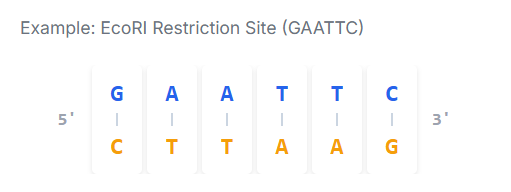
Biological Significance
- Restriction Enzyme Recognition Sites: Most type II restriction endonucleases recognize specific palindromic sequences to cleave DNA, making them indispensable tools in genetic engineering.
- Gene Regulation: These sequences are found in regulatory regions and promoters, where they act as binding sites for regulatory proteins, influencing gene expression.
- Secondary Structures: Palindromes can form hairpin or cruciform structures. These intra-strand pairings are vital for the stability, replication, and function of DNA and RNA molecules. Support: Unlike conventional tools, Palindra recognizes and processes all standard NC-UIBMB degenerate codes (e.g., Y, R, W, S, K, M, D, V, H, B) during reverse complement calculations, ensuring compatibility with complex genomic data.
- Smart Length Filtering: Users can fine-tune their search by selecting precise minimum and maximum length values from the dropdown menus to isolate specific motifs or ignore background noise.
- Automatic Data Sanitization: The tool automatically filters non-coding characters, digits, and white spaces, standardizing raw inputs for rigorous analysis.
- Interactive Visualization: Results are presented in a structured analytical table featuring 1-based positioning, sequence length, and a 5′ to 3′ directional visualization.
- Efficient Workspace: Features a “Clear All” function to quickly reset the environment for new sequence analysis.
- Multiple Export Options: Facilitates data portability by allowing users to copy results in TSV format or download CSV files for downstream analysis in spreadsheet software like Excel or Google Sheets.
Technical Overview and Algorithm
Palindra uses an optimized Sliding Window algorithm to scan DNA strands for symmetry, ensuring every possible sub-sequence within the defined parameters is evaluated for palindromic potential.
Supported Base Codes
The platform adheres to a comprehensive complementation table to maintain 100% bioinformatics accuracy:
| A | T | Adenine / Thymine |
| G | C | Guanine / Cytosine |
| Y | R | Pyrimidine / Purine |
| W | W | Weak (A/T) |
| S | S | Strong (G/C) |
| K | M | Keto / Amino |
Support and Feedback
We are dedicated to keeping this tool free and available to the global scientific community. If Palindra helps your research or studies, please consider making a donation. Your support helps us maintain servers and add new features. Your feedback is very important to us. If you find any bugs, have suggestions, or want to collaborate, please contact us through our contact page.
Credits and Development
- Algorithm: Based on optimized methodologies for nucleotide sequence analysis and symmetry detection.
- Authors: Mahdi Morshedi Yekta and Fatemeh Faryadras.
- License: Distributed under the MIT License (Open Source).
- https://github.com/mahdimorshediyekta/Palindra
Meet the Authors

Mahdi Morshedi Yekta
Founder & Bioinformatics Developer
Mahdi is the founder of ScienceCodons and a Medical Biotechnologist with a deep passion for computational biology. Holding an M.Sc. in Medical Biotechnology, he specializes in transforming complex biological algorithms into accessible, high-performance web tools, bridging the gap between laboratory sciences and software engineering.

Fatemeh Faryadras
Medical Biotechnologist & Researcher
Fatemeh is a Medical Biotechnologist and researcher. With extensive expertise in genetic engineering, molecular cloning, and cancer biology, she combines her rigorous laboratory background with intuitive design principles to create reliable, user-centered scientific calculators and tools.

Dr. Mosayeb Rostamian
Assistant Professor, Infectious Diseases Research Center
Certified Scientific Reviewer
Google ScholarExpert Review Process
To ensure the highest quality and scientific accuracy, this tool's underlying algorithms, formulas, and edge-case handling have been thoroughly reviewed and validated by Dr. Mosayeb Rostamian.
The "Reviewed By" badge signifies that an independent expert has evaluated the tool's logic to guarantee accuracy and alignment with the current consensus in the scientific community.