Bioinformatics Converter
Convert between various bioinformatics formats instantly
Paste Data
Upload File
Conversion output will appear here...
Was this tool helpful?
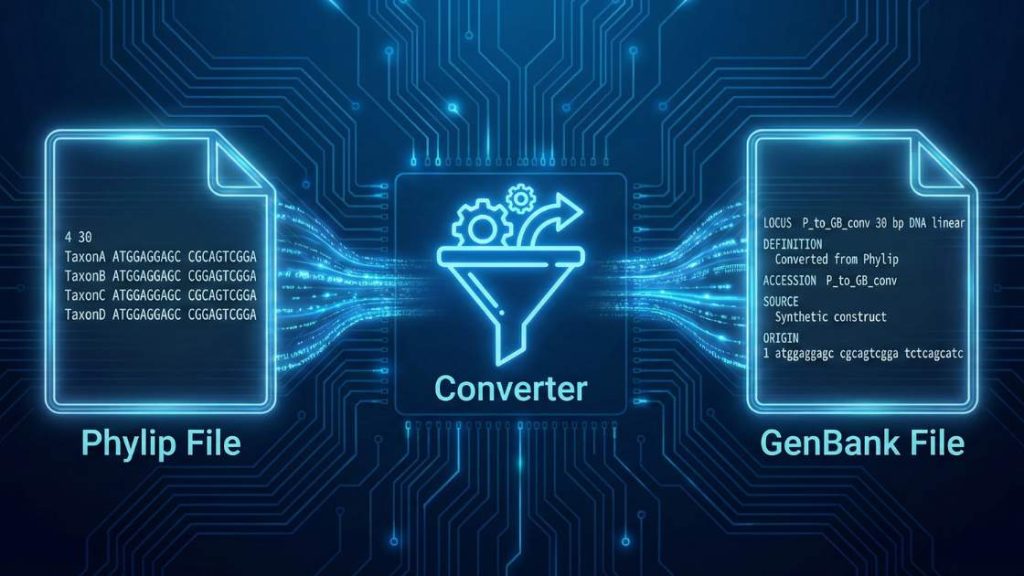
Our Phylip to GenBank Converter is an essential web-based tool that reformats molecular sequence data for advanced bioinformatics applications. It efficiently transforms multiple sequence alignments from the simple, compact phylip format into the universally recognized genbank format. This conversion enriches your data by creating a structured, annotation-ready framework for submission to public databases like NCBI or for use with sophisticated analysis and visualization software.
How to Use (Step-by-Step)
Follow these simple steps to convert your file in seconds.
- Upload Your File: Click “Upload File” or drag and drop your
.phyfile directly into the designated area. Also, you can paste the file’s content using the “Paste Data” option. - Choose Your Formats: Use the “Input Format” and “Output Format” dropdown menus for your conversion. Ensure
phylip(Phylip format) is selected as the input andgenbank(GenBank format) as the output. - Start the Conversion: Press the “Convert File” button to begin the process. The tool will process your file instantly.
- Download Your File: Once the conversion is complete, a download link for your new
.gbor.gbkfile will appear. Click it to save the file to your device.
Tip: If you encounter an error during conversion, check the Troubleshooting Guide section below—common causes and fixes are listed.
Input, Output, and Key Changes
Understanding the transformation from phylip to genbank is key to preparing your data for the next steps in your research. Here’s a breakdown of the formats and the changes that occur.
Sample Input (phylip Format)
The phylip format is a text-based format widely used in phylogenetics for representing multiple sequence alignments. Its simple structure consists of a header line indicating the number of sequences and their length, followed by sequence identifiers and the aligned sequence data, often in an interleaved or sequential block.
Example of a phylip file:
    5   38
Turkey     AAGCTNGGGC ATTTCAGGGT
Salmo gair AAGCCTTGGC AGTGCAGGGT
H. Sapiens ACCGGTTGGC CGTTCAGGGT
Chimp      AAACCCTTGC CGTTCAGGGT
Gorilla    AAACCCTTGC CGTTCAGGGT

GAGCCCGGGC AATACAGGGT AT
GAGCCGTGGC CGGGCAGGGT AT
ACAGGTTGGC CGTTCAGGGT AA
AAACCGAGGC CGTTCAGGGT AA
AAACCGAGGC CGTTCAGGGT AA
Sample Output (genbank Format)
The genbank format is the standard for the NCBI sequence database. It is a “flatfile” format that contains not only the sequence but also extensive metadata and annotations, such as the locus name, definition, accession number, source organism, and features like genes or coding regions.
Example of one sequence after conversion:
LOCUS       Turkey                  38 bp    DNA     linear   UNK 01-JAN-1980
DEFINITION  .
ACCESSION   Turkey
VERSION     Turkey
KEYWORDS    .
SOURCE      .
  ORGANISM  .
            .
FEATURES             Location/Qualifiers
ORIGIN
        1 aagctngggc atttcagggt gagcccgggc aatacagggt at
//
Key Changes in the Conversion Process
The conversion from phylip to genbank is primarily a structural transformation that prepares the data for rich annotation.
- Structural Reformatting: The most significant change is the conversion from a simple list of names and sequences to the highly structured, section-based
genbankformat. Each sequence is wrapped in its own record with distinct fields likeLOCUS,DEFINITION,FEATURES, andORIGIN. - Addition of Metadata Fields: The tool automatically generates the minimum required metadata fields for a valid
genbankfile. While many fields are initially populated with placeholders (e.g.,.or the sequence ID), this creates the necessary structure for you to add detailed information later. - Sequence Data Encapsulation: The raw aligned sequence from the
phylipfile is correctly placed within theORIGINsection of thegenbankrecord, complete with standard formatting and numbering. - Creation of an Annotation Framework: The
FEATUREStable, a critical component for annotation, is created within each record. This makes the output file ready for annotation with software that can define genes, CDS, rRNA, and other biological features.
Compatible Software
The generated genbank files are ready to be used with the following leading bioinformatics software:
- Geneious
- UGENE
- SnapGene
- NCBI Suite (BLAST, Sequin)
Troubleshooting Guide
Encountering an error can be frustrating, but most issues are easy to fix. Here are the most common problems you might face and how to resolve them.
General Tool Errors
Error: “File size exceeds the limit”
- Why it happens: Your uploaded file is larger than the maximum allowed size. Our server has this limit to ensure quick processing for all users.
- How to fix: For exceptionally large alignments, consider splitting the file into smaller chunks. For processing larger files or to inquire about unlimited usage, please contact us for custom solutions.
Error: “Processing timed out”
- Why it happens: The conversion is taking too long, which can occur with files containing an extremely high number of sequences.
- How to fix: Try simplifying your input file by reducing the number of sequences if possible. If the issue persists, please contact us to discuss options for handling larger computations.
Error: “CAPTCHA validation failed”
- Why it happens: Our system uses a CAPTCHA to prevent automated bots. This error occurs if the CAPTCHA was not solved correctly or timed out.
- How to fix: Simply reload the page and solve the new CAPTCHA. If you continue to have trouble after reloading, please get in touch with our support team.
Conversion-Specific Errors
These errors typically relate to the formatting of your phylip file.
Error: “Incorrect Header Information” or “Sequence Count Mismatch”
- Why it happens: The first line of the
phylipfile (e.g.,5 38) must contain the exact number of sequences and the precise length of the alignment. If either number is incorrect, the parser will fail. - How to fix: Manually verify the number of sequences and the number of characters (excluding the name) in one of the aligned sequences. Correct the two numbers in the header line to match your data.
Error: “Inconsistent Sequence Length”
- Why it happens: A strict requirement of the
phylipformat is that every sequence in the alignment must have the exact same length. If even one sequence is longer or shorter by a single character, the file will be considered corrupt. - How to fix: Open your file in a multiple sequence alignment viewer or a text editor that can display character counts per line. Identify the sequence(s) with incorrect lengths and either correct the alignment or remove them from the file.
Error: “Invalid Character in Sequence Name” or “Name Too Long”
- Why it happens: The strict
phylipformat requires sequence identifiers to be a fixed length (typically 10 characters) and free of spaces or special characters. Long names or names containing spaces can cause parsing to fail. - How to fix: Edit the sequence names in your
phylipfile to be 10 characters or fewer. Remove any internal spaces or special characters. If your original names were longer, be sure to keep a separate record of the full names.
If your problem isn’t listed here, we want to know about it! Please help us improve the tool by reporting the issue.
Support Our Work
We are committed to keeping our scientific tools free and accessible for everyone. If this tool has been helpful in your work, please consider supporting our mission with a donation. Your support directly helps us cover server costs and fund the development of new, powerful tools for the scientific community.
FAQ
References & Suggested Reading
This tool was developed in line with established principles in bioinformatics for accurate, reliable results. The resources listed below are foundational research and key papers that define these standards, and we highly recommend them for a deeper understanding of the scientific principles.
- Okonechnikov, K., Golosova, O., & Fursov, M. (2012). Unipro UGENE: a unified bioinformatics toolkit. Bioinformatics, 28(8), 1166–1167. https://doi.org/10.1093/bioinformatics/bts091
- Felsenstein, J. (1989). PHYLIP—Phylogeny Inference Package (Version 3.2). Cladistics, 5(2), 164–166.
- Benson, D. A., Cavanaugh, M., Clark, K., Karsch-Mizrachi, I., Ostell, J., Pruitt, K. D., & Sayers, E. W. (2018). GenBank. Nucleic Acids Research, 46(D1), D41–D47. https://doi.org/10.1093/nar/gkx1094
- Cock, P. J. A., Antao, T., Chang, J. T., Chapman, B. A., Cox, C. J., Dalke, A., Friedberg, I., Hamelryck, T., Kauff, F., Wilczynski, B., & de Hoon, M. J. L. (2009). Biopython: freely available Python tools for computational molecular biology and bioinformatics. Bioinformatics, 25(11), 1422–1423. https://doi.org/10.1093/bioinformatics/btp163
Meet the Authors

Mahdi Morshedi Yekta
Founder & Bioinformatics Developer
Mahdi is the founder of ScienceCodons and a Medical Biotechnologist with a deep passion for computational biology. Holding an M.Sc. in Medical Biotechnology, he specializes in transforming complex biological algorithms into accessible, high-performance web tools, bridging the gap between laboratory sciences and software engineering.

Fatemeh Faryadras
Medical Biotechnologist & Researcher
Fatemeh is a Medical Biotechnologist and researcher. With extensive expertise in genetic engineering, molecular cloning, and cancer biology, she combines her rigorous laboratory background with intuitive design principles to create reliable, user-centered scientific calculators and tools.

Dr. Mosayeb Rostamian
Assistant Professor, Infectious Diseases Research Center
Certified Scientific Reviewer
Google ScholarExpert Review Process
To ensure the highest quality and scientific accuracy, this tool's underlying algorithms, formulas, and edge-case handling have been thoroughly reviewed and validated by Dr. Mosayeb Rostamian.
The "Reviewed By" badge signifies that an independent expert has evaluated the tool's logic to guarantee accuracy and alignment with the current consensus in the scientific community.