Bioinformatics Converter
Convert between various bioinformatics formats instantly
Paste Data
Upload File
Conversion output will appear here...
Was this tool helpful?
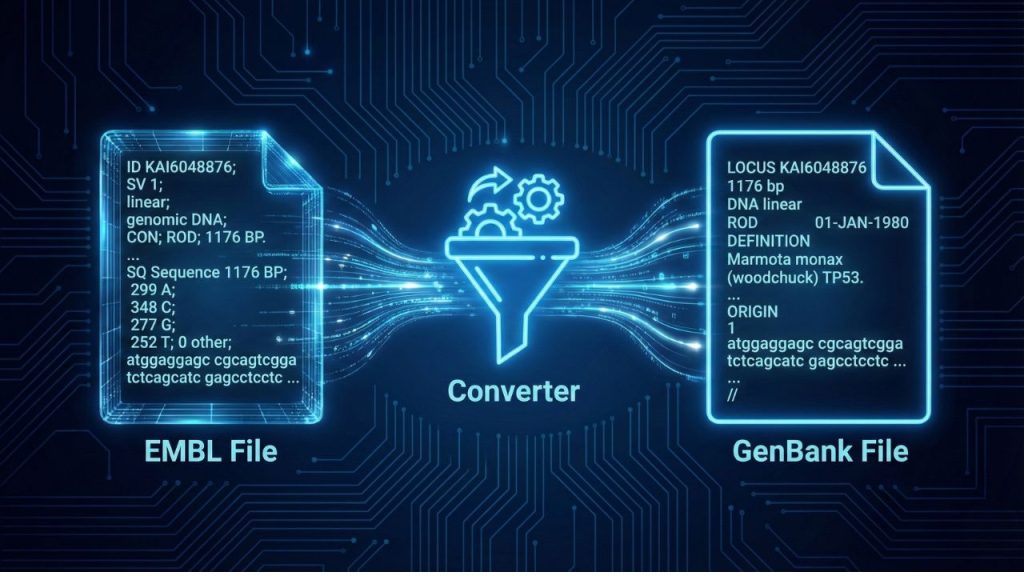
Our EMBL to GenBank Converter is a specialized web-based tool designed for molecular biologists and bioinformaticians. It efficiently transforms sequence files from the European Molecular Biology Laboratory (EMBL) format into the widely used GenBank format.
How to use (step-by-step)
Follow these simple steps to convert your file in seconds.
- Upload Your File: Click “Upload File” or drag and drop your EMBL file directly into the designated area. You can also paste the file’s content using the “Paste Data” option.
- Choose Your Formats: The input and output formats are pre-selected for your convenience. Ensure
embl(EMBL format) is selected as the input andgenbank(GenBank format) is the output. - Start the Conversion: Press the “Convert File” button to begin the process. The tool will process your file instantly.
- Download Your File: Once the conversion is complete, a download link for your new GenBank file will appear. Click it to save the file to your device.
Tip: If you see an error during conversion, check the Troubleshooting Guide below—common causes and fixes are listed.
Input, Output, and Key Changes
Understanding the structural transformation from EMBL to GenBank is key to seamless data integration in bioinformatics workflows. Here’s a breakdown of the formats and the changes that occur.
Sample Input (EMBL Format)
The EMBL format is a standard for storing nucleotide and protein sequence data, along with its annotations. It is used by the European Nucleotide Archive (ENA) and is characterized by two-letter line codes (e.g., ID, AC, FT) that define different types of information.
Example of an EMBL file:
ID   SCU49845   standard; DNA; PRO; 1557 BP.
XX
AC   U49845;
XX
DE   Saccharomyces cerevisiae TCP1-beta gene, partial cds, and Axl2p
XX
FT   CDS             23..400
FT                   /gene="TCP1-beta"
FT                   /product="TCP1-beta"
Sample Output (GenBank Format)
The GenBank format, maintained by the National Center for Biotechnology Information (NCBI), is the most widely adopted standard for sequence data. It uses descriptive keywords (e.g., LOCUS, DEFINITION, FEATURES) to organize information, making it highly readable by both humans and software.
Example of the same data in GenBank format:
LOCUS       SCU49845     1557 bp    DNA             PRO 17-SEP-2025
DEFINITION  Saccharomyces cerevisiae TCP1-beta gene, partial cds, and Axl2p.
ACCESSION   U49845
FEATURES             Location/Qualifiers
     CDS             23..400
                     /gene="TCP1-beta"
                     /product="TCP1-beta"
Key Changes in the Conversion Process
The conversion from EMBL to GenBank is primarily a reformatting of metadata and annotations to ensure compatibility.
- Header Reformatting: The most noticeable change is in the header. EMBL’s two-letter line codes (
ID,AC,DE) are translated into GenBank’s keyword-based structure (LOCUS,ACCESSION,DEFINITION). This is essential for software that is programmed to parse the GenBank header style. - Feature Table Restructuring: The annotation section is reorganized. EMBL uses a flat structure with
FTline codes for each line of the feature table. GenBank groups all features under a singleFEATURESheader, with standardized indentation for features and their qualifiers. - Preservation of Core Data: All essential information—the sequence itself, feature locations (like genes and CDS), qualifiers (like gene names), and source information—is fully retained and mapped to its correct equivalent in the GenBank format.
Compatible Software
The generated GenBank files are ready to be used with the world’s leading bioinformatics software and databases:
- NCBI Tools (including BLAST)
- SnapGene
- Geneious
- UGENE
- Benchling
Troubleshooting Guide
Encountering an error can be frustrating, but most issues are easy to fix. Here are the most common problems you might face and how to resolve them.
General Tool Errors
Error: “File size exceeds the limit”
- Why it happens: Your uploaded file is larger than the maximum allowed size. Our server has this limit to ensure quick processing for all users.
- How to fix: For very large sequence files containing multiple records, consider splitting the file into smaller chunks. For processing larger files or to inquire about unlimited usage, please contact us for custom solutions.
Error: “Processing timed out”
- Why it happens: The conversion is taking too long, which can occur with exceptionally large or complex files with extensive annotations.
- How to fix: Try to simplify your input file if possible. If the issue persists because your file is inherently complex, please contact us to discuss options for handling larger computations.
Error: “CAPTCHA validation failed”
- Why it happens: Our system uses a CAPTCHA to prevent automated bots. This error occurs if the CAPTCHA was not solved correctly or timed out.
- How to fix: Simply reload the page and solve the new CAPTCHA. If you continue to have trouble after reloading, please get in touch with our support team.
Conversion-Specific Errors
These errors typically relate to the data structure within your EMBL file.
Error: “Invalid file format” or “Unable to parse file”
- Why it happens: The input file does not strictly adhere to the EMBL format specification. This can be caused by incorrect line prefixes, misplaced data, or content from another format mixed into the file.
- How to fix: Carefully inspect your file to ensure it matches the standard EMBL format. Check for common issues like malformed header lines or feature table entries. Using a text editor with line numbering can help locate the problematic section.
Error: “Incomplete record detected”
- Why it happens: The file ends unexpectedly without the proper record terminator (
//on a new line). This often occurs when a file is partially downloaded or copied. - How to fix: Open the file in a text editor and verify that each record in the file concludes with a
//symbol on its own line. If the terminator is missing, add it to the end of the file.
Error: “Unrecognized feature key”
- Why it happens: The feature table (
FTlines) in your EMBL file contains a feature key (e.g.,my_feature) that does not conform to the International Nucleotide Sequence Database Collaboration (INSDC) standards. - How to fix: Review your feature table and correct any non-standard keys to their official INSDC counterparts (e.g.,
gene,CDS,mRNA). Refer to the ENA or NCBI documentation for a list of valid feature keys.
If your problem isn’t listed here, we want to know about it! Please help us improve the tool by reporting the issue.
Support Our Work
We are committed to keeping our scientific tools free and accessible for everyone. If this tool has been helpful in your work, please consider supporting our mission with a donation. Your support directly helps us cover server costs and fund the development of new, powerful tools for the scientific community.
FAQ
References & Suggested Reading
This tool was developed in line with established principles and standards in bioinformatics for accurate, reliable results. The resources listed below are foundational research and key papers that define these standards, and we highly recommend them for a deeper understanding of sequence data formats.
- Aken, B. L., Ayling, S., Barrell, D., Clarke, L., Curwen, V., Fairley, S., Fernandez Banet, J., Billis, K., García Girón, C., Hourlier, T., Howe, K., Kähäri, A., Kokocinski, F., Martin, F. J., Murphy, D. N., Nag, R., Ruffier, M., Schuster, M., Tang, Y. A., … Flicek, P. (2016). The Ensembl gene annotation system. Database, 2016, baw093. https://doi.org/10.1093/database/baw093
- Kanz, C., Aldebert, P., Althorpe, N., Baker, W., Baldwin, A., Bates, K., Browne, P., van den Broek, A., Castro, M., Cochrane, G., Duggan, K., Fedotov, A., Flicek, P., Gibson, R., Hamann, T., Kalia, V., Karsch-Mizrachi, I., Kulikova, T., Lin, Q., … Apweiler, R. (2005). The EMBL Nucleotide Sequence Database. Nucleic Acids Research, 33(Database issue), D29–D33. https://doi.org/10.1093/nar/gki024
- Benson, D. A., Karsch-Mizrachi, I., Clark, K., Lipman, D. J., Ostell, J., & Sayers, E. W. (2018). GenBank. Nucleic Acids Research, 46(D1), D41–D47. https://doi.org/10.1093/nar/gkx1024
- Cock, P. J. A., Antao, T., Chang, J. T., Chapman, B. A., Cox, C. J., Dalke, A., Friedberg, I., Hamelryck, T., Kauff, F., Wilczynski, B., & de Hoon, M. J. L. (2009). Biopython: freely available Python tools for computational molecular biology and bioinformatics. Bioinformatics, 25(11), 1422–1423. https://doi.org/10.1093/bioinformatics/btp163
Meet the Authors

Mahdi Morshedi Yekta
Founder & Bioinformatics Developer
Mahdi is the founder of ScienceCodons and a Medical Biotechnologist with a deep passion for computational biology. Holding an M.Sc. in Medical Biotechnology, he specializes in transforming complex biological algorithms into accessible, high-performance web tools, bridging the gap between laboratory sciences and software engineering.

Fatemeh Faryadras
Medical Biotechnologist & Researcher
Fatemeh is a Medical Biotechnologist and researcher. With extensive expertise in genetic engineering, molecular cloning, and cancer biology, she combines her rigorous laboratory background with intuitive design principles to create reliable, user-centered scientific calculators and tools.

Dr. Mosayeb Rostamian
Assistant Professor, Infectious Diseases Research Center
Certified Scientific Reviewer
Google ScholarExpert Review Process
To ensure the highest quality and scientific accuracy, this tool's underlying algorithms, formulas, and edge-case handling have been thoroughly reviewed and validated by Dr. Mosayeb Rostamian.
The "Reviewed By" badge signifies that an independent expert has evaluated the tool's logic to guarantee accuracy and alignment with the current consensus in the scientific community.