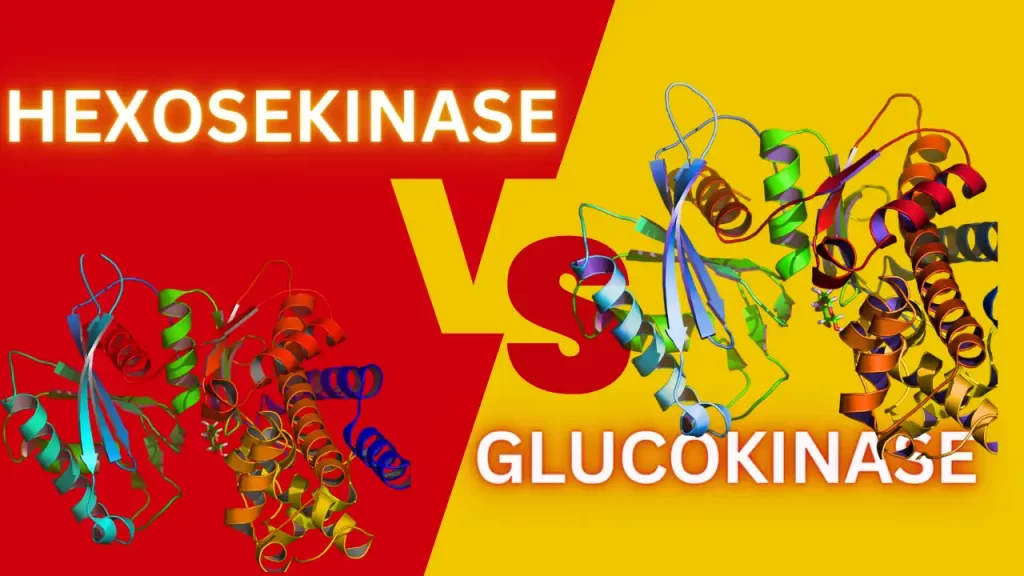
Glucose metabolism is central to cellular bioenergetics and is the main energy source for most organisms. Hexokinase and glucokinase are two enzymes that play a crucial role in glucose metabolism. They convert glucose to glucose 6-phosphate (adding a phosphate group to the sixth carbon of glucose, using ATP as the phosphate donor). Their action results in the formation of glucose 6-phosphate, effectively trapping glucose inside the cell and preparing it for further metabolism.
Although both enzymes catalyze the same biochemical reaction, their distinct properties support specialized biological functions. This article offers a comparative analysis of hexokinase and glucokinase, focusing on key differences in tissue distribution, substrate affinity (Km), regulatory mechanisms, and physiological roles in energy balance.
Location:
Hexokinase: This enzyme is found in various tissues throughout the body, including muscle and fat tissues. It is present in most cells, allowing them to utilize glucose efficiently.
Glucokinase: This enzyme is primarily found in the liver and pancreatic beta cells. Its presence in the liver is particularly important for regulating blood glucose levels.
Affinity for Glucose:
Hexokinase has a high affinity for glucose, meaning it can effectively phosphorylate glucose even at low concentrations. This allows tissues to capture glucose when it is available. However, glucokinase has a lower affinity for glucose than hexokinase, which means it is more effective when glucose levels are high (e.g., after a meal). This allows the liver to manage glucose storage and release based on the body’s needs.
Regulation:
Hexokinase is inhibited by its product, glucose-6-phosphate. This feedback inhibition helps to prevent excessive accumulation of glucose-6-phosphate when energy needs are met. Glucokinase is not subject to the same feedback inhibition by glucose-6-phosphate. Instead, its activity is regulated by insulin. When insulin levels are high, glucokinase activity increases, promoting glucose uptake and storage in the liver.
Physiological Role:
Hexokinase: Plays a crucial role in maintaining cellular energy levels in various tissues by allowing them to utilize glucose quickly.
Glucokinase: Functions mainly to help regulate blood glucose levels and to store excess glucose as glycogen in the liver when energy is plentiful.
| Property | Glucokinase | Hexokinase |
|---|---|---|
| Location in body | Liver and pancreatic beta cells | All tissues |
| Location in cell | cytosol | nucleus |
| Substrate specificity | High for glucose, low for other hexoses | Low for glucose, high for other hexoses |
| Affinity for Glucose | Low | High |
| Km | High Km | Low Km |
| Activity | Active only when more glucose is present | Active all the time |
| Km Value | High | Low |
| Inhibition by glucose-6-phosphate | No | Yes |
| Regulation | Induced by insulin, inhibited by glucagon | Constitutive expression |
| Role | Controls blood glucose level, initiates glycogen synthesis | Provides glucose-6-phosphate for glycolysis and other pathways |
| Enzyme stability | Low | High |
In conclusion, glucose phosphorylation, the first and irreversible step of glycolysis, is carried out by two enzyme groups: Hexokinases (I-III), which are widely distributed, and Glucokinase (Hexokinase IV), which is specialized. Hexokinases have a high affinity for glucose, allowing peripheral tissues to meet their energy needs even at low glucose levels. In contrast, Glucokinase functions as a high-threshold glucose sensor in the liver and pancreatic beta cells, responding primarily to elevated glucose levels after meals due to its lower affinity. This difference in affinity and tissue distribution ensures that most cells maintain a steady energy supply, while the liver and pancreas regulate systemic glucose levels and insulin, which is essential for preventing metabolic disorders such as diabetes mellitus.
Reference:
- Lodish, Harvey., Berk, Arnold., Kaiser, Chris., Krieger, Monty., Bretscher, Anthony., Ploegh, Hidde., MARTIN, Kelsey., Yaffe, Michael., Amon, Angelika. Molecular Cell Biology. United States: Macmillan Learning, 2021.
- Lodish, Harvey, et al. Molecular Cell Biology. United States, W. H. Freeman, 2020.
- Nelson, David Lee, et al. Lehninger Principles of Biochemistry. United States, W.H. Freeman, 2008.