If you work with structural biology data, you’ve likely seen the terms CIF and mmCIF used frequently, perhaps even interchangeably. But are they really the same thing? This article clarifies the crucial differences between these two key standards developed by the International Union of Crystallography (IUCr), helping you understand their distinct roles in modern structural data.
History of CIF and mmCIF: Evolution of Data Standards

The Crystallographic Information File (CIF) was introduced by the International Union of Crystallography (IUCr) in 1991. Its mission was to provide a universal, computer-readable syntax for crystallographic data—a flexible alternative to older, rigid formats. CIF defines how data should be structured (its grammar and syntax), not necessarily what data should be included.
Example from a classic CIF file (for a small molecule like benzene):
In a CIF file for a small molecule, the data is concise and focused on fundamental crystallographic and chemical details.
_chemical_formula_sum      'C6 H6'
_cell_length_a           7.460
_cell_length_b           9.666
_cell_length_c           7.034

loop_
_atom_site_label
_atom_site_fract_x
_atom_site_fract_y
C1 0.0489 0.1389
...
Notice the focus on cell parameters and basic atomic coordinates.
However, as macromolecular biology expanded, CIF’s simplicity became a limitation. Large protein complexes, experimental conditions, and refinement statistics required a far richer representation. Rather than inventing a new format, researchers extended CIF’s syntax—creating the macromolecular CIF (mmCIF) in 1997. Often referred to as PDBx/mmCIF, it introduced an extensive dictionary of thousands of tags to describe every detail of macromolecular structures. By 2014, the Protein Data Bank (PDB) had officially adopted mmCIF as its archival standard.
Example from an mmCIF file (for a protein like lysozyme):
In contrast, an mmCIF file for a protein contains a much richer set of metadata describing the biological and experimental context.
_entity.id                   1
_entity.type                 polymer
_entity.pdbx_description     Lysozyme

_exptl.method                'X-RAY DIFFRACTION'

_refine.ls_R_factor_R_free   0.210

loop_
_atom_site.group_PDB
_atom_site.id
_atom_site.label_atom_id
...
ATOM 1 N ...
...
Here, in addition to atomic coordinates, we see tags for the molecule’s description (_entity.pdbx_description), experimental method (_exptl.method), and quality metrics (_refine.ls_R_factor_R_free)—details absent in the simpler CIF.
Differences Between CIF and mmCIF
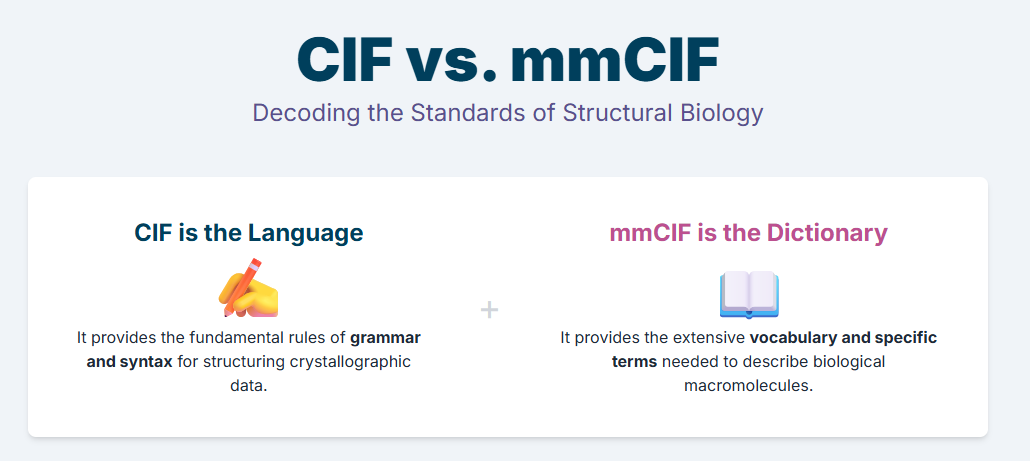
The easiest way to grasp the relationship is with a simple analogy: CIF is the language, while mmCIF is the specialized dictionary for biology.
- CIF (The Language) provides the fundamental rules of grammar and structure. It dictates that data items must start with an underscore (_) and that tables of data must begin with
loop_. It provides the framework, but no actual scientific terms. - mmCIF (The Dictionary) provides the specific vocabulary needed for biology. It contains thousands of precise terms (tags) like
_atom_site.Cartn_xfor an atom’s X-coordinate or_refine.ls_R_factor_R_freefor quality metrics. It provides the meaningful content that fills the CIF structure.
One is useless without the other. The CIF syntax provides the structure, and the mmCIF dictionary provides the content.
Key Differences in Practice
While they share the same syntax, their practical applications and capabilities diverge significantly:
- Scope & Vocabulary: The traditional CIF dictionaries are tailored for small molecules. In contrast, the mmCIF format uses the vastly more extensive PDBx/mmCIF dictionary, which is essential for describing the intricate details of large biological macromolecules and their experimental context.
- Size & Complexity: The mmCIF standard was specifically designed to eliminate the size limitations of older formats. Since 2014, it has been the only format capable of archiving the largest structures in the PDB as single, complete files.
- Extensibility: The mmCIF framework is designed to be future-proof. New dictionaries can be added to support emerging data types without altering the core standard. A prime example is ModelCIF, an extension developed to archive computational models from tools like AlphaFold, including metadata about the prediction process.
Real-World Examples: The Difference in Action

The best way to see the difference is to compare snippets from actual files. Both use CIF syntax, but their content tells a different story. These examples clearly show how mmCIF uses the CIF syntax to build a far richer, more descriptive data standard tailored for the complex needs of structural biology.
| Feature | CIF | mmCIF |
|---|---|---|
| Primary Role | Defines the syntax (grammar). | Defines the biological vocabulary. |
| Use Case | Small molecule crystallography. | Proteins, nucleic acids, large complexes. |
| Data Scope | Basic crystallographic definitions. | Thousands of detailed biological and experimental terms. |
| Extensibility | Limited. | Highly extensible (e.g., ModelCIF for computational models). |
| Adopted by PDB | No. | Yes (since 2014). |
Modern molecular software such as PyMOL, ChimeraX, and CCP4 now rely on mmCIF as their primary format, reflecting its flexibility and completeness.
FAQ
Why do files from the PDB still have a .cif extension if they use the mmCIF dictionary?
.cif refers to the syntax being used, which is the universal CIF standard. The content inside that file, however, follows the specific mmCIF dictionary. So, the file name indicates the “language,” while the data inside uses the biological “dictionary.”Can I use a standard CIF parser to read an mmCIF file?
loop_ structures, etc.) will be able to read the structure of an mmCIF file. However, that software will only understand the meaning of the data tags if it is also aware of the mmCIF dictionary.Does mmCIF support non-crystallographic structures (like cryo-EM)?
How can I open an mmCIF file?
Are there any limitations to mmCIF?
Can mmCIF store experimental metadata beyond atomic coordinates?
Conclusion
In essence, while CIF provides the universal syntax, mmCIF provides the essential biological vocabulary. In the world of structural biology, when someone refers to a “CIF file,” they are almost always talking about a file that uses the powerful mmCIF dictionary and is formatted according to the CIF syntax. The two work together as partners to create the powerful, modern standard for structural data.
Your choice of which to focus on depends entirely on your scientific domain. For any work involving macromolecular structures like proteins, RNA, or large complexes, or for depositing data to the PDB, you should exclusively use mmCIF/PDBx as it is the official, flexible, and limitless standard for the field. For small molecule crystallography and traditional processing workflows, the classic CIF format may be sufficient, but an awareness of mmCIF remains crucial for modern data exchange and archiving.
References
-
- Hall, S. R., Allen, F. H., & Brown, I. D. (1991). The Crystallographic Information File (CIF): a new standard archive file for crystallography. Acta Crystallographica Section A, 47(6), 655-685.
- Bourne, P. E., Berman, H. M., Watenpaugh, K., Westbrook, J. D., & Fitzgerald, P. M. D. (1997). The macromolecular Crystallographic Information File (mmCIF). Methods in Enzymology, 277, 571-590.
- Westbrook, J. D., & Bourne, P. E. (2000). The Protein Data Bank and lessons in data management. Briefings in Bioinformatics, 1(2), 159-168.