Although the chemical processes necessary to support life—from breaking down food to copying DNA—would ordinarily take years or even centuries to complete, life functions on a timescale measured in seconds and minutes. The solution to this biological paradox lies with enzymes, nature’s master catalysts. Enzymes are predominantly proteins that dramatically accelerate the rate of biochemical reactions without being consumed in the process. They enable life by accelerating reactions by a factor of a million or more. The fundamental ideas behind how these extraordinary molecules accomplish such amazing things are explained in this guide.
What Are Enzymes?
Enzymes serve as essential biological catalysts, primarily composed of proteins, that facilitate and accelerate the multitude of biochemical reactions required for life. Enzymes can amplify reaction rates by factors of millions. Carbonic anhydrase in human blood, for example, speeds up the conversion of carbon dioxide to bicarbonate ions by about 10 million times, which is essential for preserving pH balance and effective breathing.
A defining feature of enzymes is that they are not consumed in the reactions they catalyze, which allows a single enzyme molecule to be reused over and over again. A well-known example is lactase, the enzyme responsible for breaking down lactose in dairy products. Individuals deficient in lactase often experience difficulty digesting milk and other related products.
Enzymes are classified into seven major categories based on the type of reaction they facilitate and exhibit a remarkable diversity of functions, which we fully explained here. Additionally, for enzymes to work as best they can, cofactors and coenzymes – such as vitamins or metal ions – may be necessary.
Understanding Activation Energy
Activation energy is an energy barrier that must be overcome by any chemical reaction, whether it takes place in a living cell or a test tube. This is the least amount of energy needed to bend reactant molecules into the transition state, an unstable, high-energy arrangement, where existing chemical bonds can break and new ones can form.
Unless sufficient energy is expended to push the boulder (the reactants) to the summit of the mountain (the transition state), it will not reach the valley on the opposite side (the products). Without that initial energy input, the boulder rolls back down, and no reaction occurs.
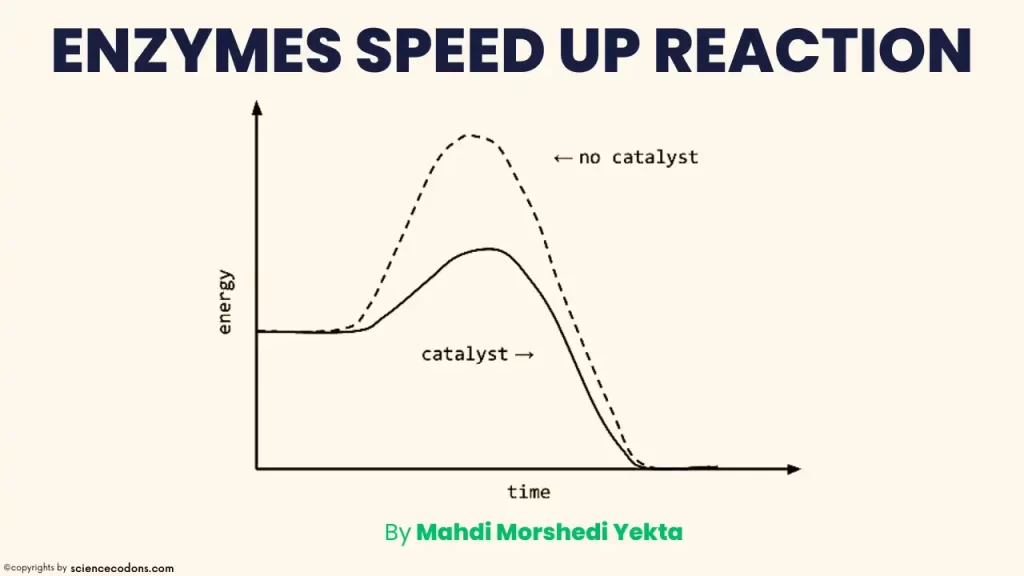
In uncatalyzed reactions, overcoming this barrier often demands external inputs like high temperatures or pressures, which are impractical in biological systems where such extremes could denature proteins or disrupt cellular integrity. Enzymes circumvent this by offering an alternative pathway that reduces the height of the energy peak, allowing reactions to occur swiftly at physiological temperatures.
This is usually shown in a reaction progress diagram, where energy levels are shown on the vertical axis and the reaction coordinate is tracked on the horizontal. The enzyme-catalyzed version has a softer incline, indicating a lower activation energy, while the uncatalyzed reaction curves upward to a high peak before descending. Importantly, enzymes only speed up the process of reaching equilibrium; they have no effect on the overall free energy change (ΔG) between reactants and products.

The table below compares key aspects:
| Feature | Uncatalyzed Reaction | Enzyme-Catalyzed Reaction |
|---|---|---|
| Activation Energy | High, requiring more input (e.g., via heat or pressure) to reach the transition state. | Lowered through stabilization of the transition state, enabling reactions at ambient conditions. |
| Reaction Rate | Slow and often impractical in biological contexts | Rapid and biologically viable |
| Overall Energy Change | Unchanged; the reaction’s thermodynamics remain the same, but kinetics are unaffected. | Unchanged; enzymes affect only kinetics, not equilibrium. |
| Typical Conditions | Harsh, requiring extremes like high temperatures (>100°C) or strong acids/bases to overcome activation energy. | Mild, optimized for physiological environments (e.g., 37°C body
temperature, neutral pH ~7, as in human cells). |
This reduction in activation energy is what makes enzymes indispensable, transforming sluggish processes into dynamic ones essential for survival.
How Enzymes Lower Activation Energy
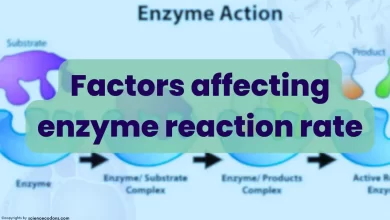
The complex processes by which enzymes accomplish their catalytic abilities start with substrate binding at the active site, forming a transient enzyme-substrate complex. Two important models have been created by scientists to describe the interactions between an enzyme and its substrate.
- The “Lock-and-Key” Model: Proposed in 1894, this early model suggested that the active site of the enzyme and its substrate have rigid, perfectly complementary shapes, similar to a key fitting into a particular lock. Although this clarified the specificity of the enzyme, it was unable to explain the catalytic process itself.
- The “Induced-Fit” Model: The modern and more accurate model, proposed in 1958, views the enzyme as a flexible structure. When the substrate binds, it induces a conformational change in the enzyme, which causes the active site to perfectly fit the substrate. A hand fitting into a flexible glove is a more accurate comparison. The secret to catalysis is this dynamic interaction. The substrate’s chemical bonds are strained by the tightening grip, which causes it to move toward the transition state and lowers the activation energy.
These binding events reduce activation energy in a number of ways:
- Proximity and Orientation Effects: bringing substrates into proper alignment and close proximity.
- Transition State Stabilization: Active sites provide an environment that stabilizes high-energy intermediates.
- Acid–Base Catalysis: Donation or acceptance of protons facilitates bond cleavage or formation.
- Covalent Catalysis: Formation of transient covalent bonds between the enzyme and substrate.
- Electrostatic Stabilization: Interactions between charges in the active site stabilize intermediates and reduce repulsion.
Through these precise structural adaptations and strategic interactions, enzymes lower energy barriers, making complex biochemistry feasible in the delicate balance of living systems.
Applications and Importance of Enzymes in the Real World
To bridge theory with practice, consider these enzymes and their roles in everyday biology and industry.
- In Digestion: Our bodies rely on a host of digestive enzymes. Pepsin breaks down proteins in the stomach, lipase breaks down fats in the small intestine, and salivary amylase in the mouth starts to break down starches.
- In Food Production: Enzymes are essential tools in manufacturing. Rennet is an enzyme that coagulates milk in the process of making cheese. Amylases transform starch into fermentable sugars during baking and brewing.
- In Industry: Enzymes extend their utility beyond cellular boundaries, transforming biotechnology and industry. To break down and get rid of stains, modern detergents employ a combination of proteases, lipases, and amylases. Biofuels leverage cellulases to degrade plant biomass efficiently, promoting sustainable energy. Thermostable polymerases from extremophile bacteria are essential for biotechnological advancements like PCR for DNA amplification, which facilitate research and diagnostics.
This article was reviewed for accuracy by Dr. Mosayeb Rostamian. The content is based on current scientific evidence and is intended for educational purposes only.
Conclusion
Enzymes convert slow chemical reactions into effective biological necessities by reducing activation energy through complex binding and stabilization mechanisms. From digestive aids like amylase to industrial processes like proteases, their roles are diverse and indispensable, influenced by various factors. A thorough understanding of enzyme mechanisms is fundamental not only to the study of biology but also to advancements in medicine, biotechnology, and industrial applications.
Reference:
- Enzymes: Moving at the speed of life. (n.d.). American Chemical Society. Retrieved September 5, 2025, from https://www.acs.org/education/celebrating-chemistry-editions/2021-ncw/enzymes.html
-
Cooper, G. M. (2000). The central role of enzymes as biological catalysts. In The Cell: A Molecular Approach. 2nd edition. Sinauer Associates. https://www.ncbi.nlm.nih.gov/books/NBK9921/