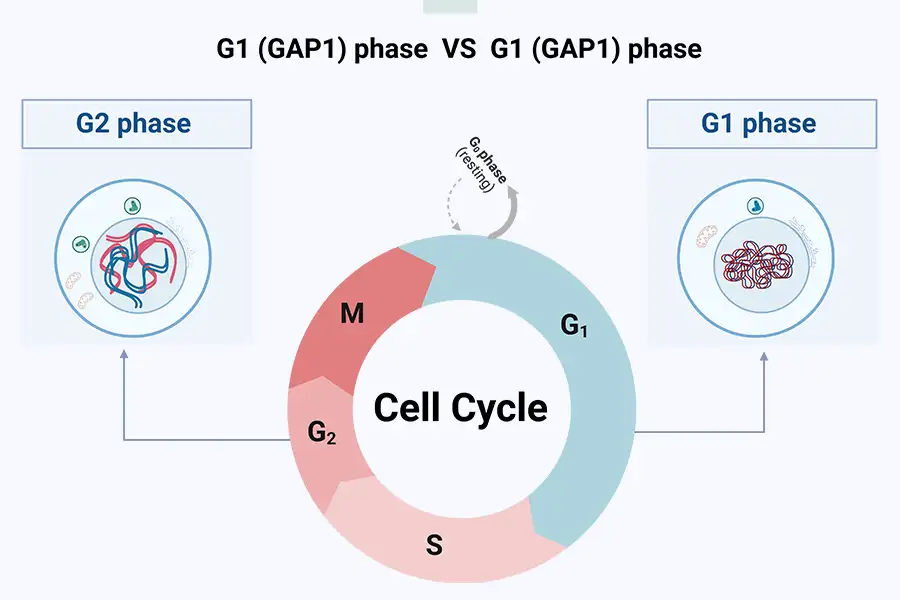
G1 phase
The G1 phase of the cell cycle serves the purpose of preparing the cell for replication. During this phase, the cell increases the number of organelles, synthesizes proteins and enzymes needed for DNA replication, and repairs any DNA damage, such as thymine dimers. The G1 phase is critical for preparing the cell for DNA replication and duplication in the S phase of the cell cycle.

- The cell grows physically larger
- increasing synthesize of RNA and Protein
- increasing number of ribosome
G2 phase
The G2 phase of the cell cycle is crucial for ensuring that all DNA replication in the S phase has been completed accurately and any errors are corrected before the cell proceeds to division in mitosis. During the G2 phase, the cell undergoes further growth, synthesizes more proteins and enzymes, and prepares for cell division by checking for any DNA damage or errors that need to be repaired. The primary purpose of the G2 phase is to ensure that the cell is fully prepared for division in mitosis and that the genetic material is intact and ready to be passed on to the daughter cells.

- The cell undergoes cellular growth, resulting in increased production of proteins and organelles.
G1 vs G2 phase
In this table, I try to summarize the main differences between the G1 and G2 phases.
| Characteristic | G1 Phase | G2 Phase |
|---|---|---|
| Purpose | Prepare the cell for DNA replication | Ensure DNA replication was completed accurately and prepared for cell division |
| Cell Growth | Cell increases organelles, proteins, and enzymes | The cell undergoes further growth and prepares for division |
| DNA Replication | DNA is not replicated, but the cell repairs any damage | DNA replication from the S phase is checked for errors |
| Cell Division | The cell is not ready for division, focuses on the preparation | The cell is ready to proceed to mitosis and divide |
| Key Processes |
|
|
Reference:
- Lodish, H., Berk, A., Kaiser, C. A., Krieger, M., Bretscher, A., Ploegh, H., Amon, A., Martin, K. C. (2016). Loose-leaf Version for Molecular Cell Biology. (n.p.): W. H. Freeman.
- biorender.com