Imagine being able to see inside a living animal, to observe a beating heart or blood vessels flowing through the brain – all without surgery! While it might sound like science fiction, it’s true. Scientists have just made a groundbreaking discovery that’s changing the way we study biology: they’ve figured out how to make living skin transparent. The value is that by making the skin clear, researchers can observe internal organs and biological processes in real-time without harming the animal.
Hello everyone, and Welcome back to ScienceCodons, where we dive into the latest and greatest scientific discoveries. In today’s episode, we will talk about one of the coolest recent scientific news: transparent Living Skin, which researchers have made a reality. Let’s explore how they did it.
In a groundbreaking study published on September 6, 2024, in the journal Science, researchers from The University of Texas at Dallas and Stanford University have developed a method to make the skin of live mice transparent. The team discovered that applying a mixture of water and a common yellow food coloring called tartrazine could make the skin of live mice see-through.
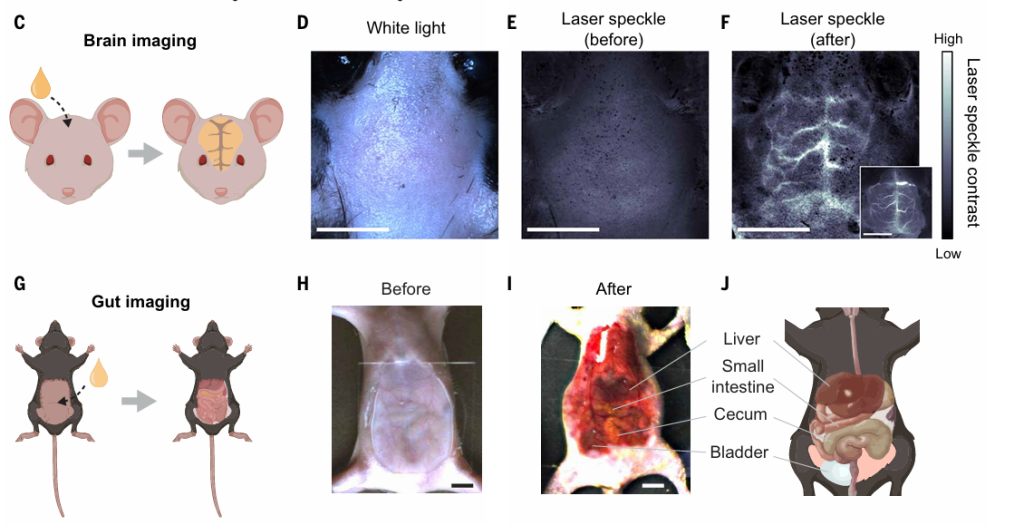
In their experiments, researchers applied the tartrazine solution to various areas of the skin of live mice, including their skulls and abdomens. Through the transparent skin of the skull, researchers directly observed blood vessels on the surface of the brain. In the abdomen, they observed internal organs and peristalsis, the muscle contractions that move contents through the digestive tract.
How does a food dye unlock the secrets of our skin?
Living skin is a scattering medium, meaning it scatters light, making it opaque. The yellow dye, tartrazine, absorbs most light, especially blue and ultraviolet light. When this dye is combined with the skin, it reduces the degree to which light scatters, making the skin transparent. This happens because the dye changes the refractive index of the skin, matching it with the tissue components like lipids. It’s like dissipating a fog bank, allowing light to pass through more freely. Although this seems magical to be used in medical fields, the researchers have not yet tested the process on humans, whose skin is about ten times thicker than a mouse’s.

How reversible is this effect, and is it safe?
One of the most exciting aspects of this discovery is that the transparency effect lasted for several hours and was completely reversible. Simply washing off the solution with water restored the skin to its normal state. Also, the dye that has diffused into the skin is metabolized and excreted through urine, making it a safe and non-invasive method. This is the reason that tartrazine has been approved for use in the food industry.
What are the real-world applications?
Visualizing internal structures has traditionally relied heavily on X-rays, CT scans, and MRIs. While these technologies are invaluable, they often involve radiation exposure, high costs, and may not provide the level of detail needed for specific diagnoses. This is here where the potential applications of transparent skin can change the whole story:
- For example, in Medical Diagnostics, Transparent skin could revolutionize medical imaging. Doctors could diagnose diseases, monitor the progress of treatments, and detect tumors without the need for invasive procedures.
- Also, in Surgical Guidance, Surgeons could use transparent skin to visualize internal structures in real time, improving the accuracy and precision of operations.
- Moreover, in Basic Biology Research, Transparent skin offers novel opportunities to study the development, function, and interactions of organs and systems in living organisms.
In conclusion, developing a method to make living skin transparent using a simple food dye is a remarkable achievement in medical science. This breakthrough not only opens up new possibilities for non-invasive medical diagnostics and treatments but also showcases the innovative ways in which everyday substances can be repurposed for advanced scientific applications. As we continue to explore the potential of this technique, we can look forward to a future where medical procedures are safer, more efficient, and less invasive.
This article was reviewed for accuracy by Dr. Bahman Akbari. The content is based on current scientific evidence and is intended for educational purposes only. It does not constitute medical advice and should not be used as a substitute for consultation with a qualified health professional.
References📚:
- www.sciencedaily.com/releases/2024/09/240905143615.htm
- news.utdallas.edu/science-technology/yellow-dye-solution-transparent-skin-2024/
- https://www.science.org/doi/full/10.1126/science.adm6869