Calculating molecular weight (MW) is one of the most common, boring tasks in chemistry, biochemistry, and laboratory work. In principle, the calculation is simple: add together the atomic weights of all atoms in a chemical formula. In practice, however, complex formulas, parentheses, hydrates, repeated groups, and biomolecular sequences can make the process surprisingly error-prone!
In this guide, we will explain what molecular weight means and walk you through a step-by-step manual calculation using practical examples. We will also show you how to calculate molecular weight instantly with our Online Molecular Weight Calculator, which handles everything from simple compounds to larger biomolecules such as peptides and nucleic acids. To make this page a complete reference, we have included an atomic weights table for all elements at the end of the guide.
What is Molecular Weight?
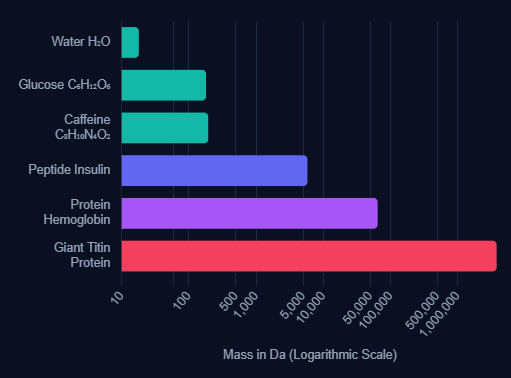
Molecular weight, also called molecular mass, is the total mass of all atoms within a single molecule. It is calculated by summing the atomic weights of all atoms in the molecular formula. Molecular weight is typically expressed in Atomic Mass Units (amu) or Daltons (Da), where 1 amu is equivalent to 1 Da. The term Dalton is especially common in biochemistry and molecular biology to describe large biomolecules, such as proteins, peptides, and nucleic acids, often expressed in kilodaltons (kDa).
Mathematically, 1 amu (or 1 Da) is defined as exactly 1/12 of the mass of a single carbon-12 atom. When you scale things up to work with practical amounts in a laboratory, we use Grams per Mole (g/mol) to represent molar mass, which is the total mass of one mole (6.022 x 10²³ formula units) of that substance.
Before we start calculating, let’s clarify three terms that are often confused in textbooks and labs. While they are related, they actually mean slightly different things:
| Term | Definition | Typical Unit | Practical Example (Water) |
|---|---|---|---|
| Molecular Weight / Mass | Mass of a single covalent molecule. | amu or Da | 18.015 amu |
| Formula Weight / Mass | Mass of a single formula unit of an ionic compound (like NaCl). | amu or Da | 58.44 amu |
| Molar Mass | Mass of one mole (6.022 x 10²³ particles) of a substance. | g/mol | 18.015 g/mol |
Molecular Weight (MW) Calculation
You can calculate molecular weight either by hand or with an online tool. Doing it manually helps you learn each step, while an online calculator saves time and helps avoid mistakes, especially with complex formulas. To calculate molecular weight manually, you only need three basic things:
1. A chemical formula
2. A periodic table of elements
3. A calculator
This method is ideal for learning how molecular weight is derived and for working through simple examples.
For more complex formulas, an online tool is often faster and more practical. Our Online Molecular Weight Calculator instantly analyzes chemical formulas and handles complicated structures with greater convenience. This is especially helpful when working with large molecules, repeated groups, peptides, nucleic acids, or formulas that are easy to misread by hand.
In the next section, we will walk through the manual calculation method first, then show you how to use the online calculator as a quick alternative.
The 5-Step Formula to Calculate Molecular Weight
You can use these five simple steps for any chemical compound:
Step 1: Identify the chemical formula
Write down the formula of the molecule you want to calculate (e.g., sulfuric acid: H₂SO₄).
Step 2: List all the elements present
Identify each unique chemical symbol in the formula. For H₂SO₄, we have:
- Hydrogen (H)
- Sulfur (S)
- Oxygen (O)
Step 3: Count the number of atoms for each element
Look at the subscripts (the small numbers next to the elements). If there is no subscript, it means there is exactly 1 atom.
- Hydrogen (H) = 2 atoms
- Sulfur (S) = 1 atom
- Oxygen (O) = 4 atoms
Step 4: Find the atomic weight of each element
Look up the atomic weights on the periodic table. (Usually, rounding to two decimal places is standard):
- Hydrogen (H) ≈ 1.01 amu
- Sulfur (S) ≈ 32.06 amu
- Oxygen (O) ≈ 16.00 amu
Step 5: Multiply, sum up, and write the final unit
Multiply the number of atoms by their atomic weight, then add them all together:
Total Mass = (Atoms of Element A x Weight of A) + (Atoms of Element B x Weight of B) + …
Practical Examples (From Simple to Complex)
Now that you are familiar with how to manually calculate the molecular weight of compounds, it’s time to roll up our sleeves and solve some examples together. We will start from a simple level, calculating the molecular weight of a single water molecule, and work our way up to highly complex compounds.
Example 1: Water (H₂O) – Simple Covalent Compound
- Formula: H₂O
- Elements and Atoms:
- Hydrogen (H): 2 atoms
- Oxygen (O): 1 atom
- Atomic Weights:
- H = 1.01 amu
- O = 16.00 amu
- Calculation:
-
- Contribution of H: 2 x 1.01 = 2.02 amu
- Contribution of O: 1 x 16.00 = 16.00 amu
-
Molecular Weight of H₂O = 2.02 + 16.00 = 18.02 amu
Example 2: Glucose (C₆H₁₂O₆) – Medium Organic Molecule

- Formula: C₆H₁₂O₆
- Elements and Atoms: Carbon (C): 6 atoms, Hydrogen (H): 12 atoms, Oxygen (O): 6 atoms
- Atomic Weights: C = 12.01 amu, H = 1.01 amu, O = 16.00 amu
- Calculation:
- Contribution of C: 6 x 12.01 = 72.06 amu
- Contribution of H: 12 x 1.01 = 12.12 amu
- Contribution of O: 6 x 16.00 = 96.00 amu
Molecular Weight of Glucose = 72.06 + 12.12 + 96.00 = 180.18 amu
Example 3: Calcium Phosphate (Ca₃(PO₄)₂) – Complex Compound with Parentheses
When a chemical formula contains parentheses, the subscript outside the parentheses multiplies everything inside it.
- Formula: Ca₃(PO₄)₂
- Deconstructing the Parentheses:
-
- Calcium (Ca): 3 atoms
- Phosphorus (P): 1 x 2 = 2 atoms
- Oxygen (O): 4 x 2 = 8 atoms
-
- Atomic Weights:
-
- Ca = 40.08 amu
- P = 30.97 amu
- O = 16.00 amu
-
- Calculation:
-
- Contribution of Ca: 3 x 40.08 = 120.24 amu
- Contribution of P: 2 x 30.97 = 61.94 amu
- Contribution of O: 8 x 16.00 = 128.00 amu
-
Formula Weight of Ca₃(PO₄)₂ = 120.24 + 61.94 + 128.00 = 310.18 amu
Example 4: Copper(II) Sulfate Pentahydrate (CuSO₄ · 5H₂O) – Advanced Hydrated Salt
Many chemical salts exist as hydrates, with water molecules bound within their crystal structures. The dot (·) does not mean mathematical multiplication; it indicates that the water molecules must be added to the overall mass.
- Formula: CuSO₄ · 5H₂O
- Deconstructing the Formula:
- Copper (Cu): 1 atom
- Sulfur (S): 1 atom
- Oxygen (O from CuSO₄): 4 atoms
- Water molecules (H₂O): 5 molecules (which means 10 Hydrogen atoms and 5 Oxygen atoms)
- Atomic Weights:
- Cu = 63.55 amu
- S = 32.06 amu
- O = 16.00 amu
- H = 1.01 amu
- Calculation:
-
- Contribution of anhydrous CuSO₄: 63.55 + 32.06 + (4 x 16.00) = 159.61 amu
- Contribution of 5 water molecules (5H₂O): 5 x [ (2 x 1.01) + 16.00 ] = 5 x 18.02 = 90.10 amu
-
Formula Weight of CuSO₄ · 5H₂O = 159.61 + 90.10 = 249.71 amu
Common Mistakes to Avoid
Even experienced chemistry students can make simple mistakes when calculating molecular weights. Keep these tips in mind to avoid errors:
- The “Hydrate Dot” Trap: In hydrates such as CuSO₄·5H₂O, the dot does not mean multiplication. This means that water molecules are associated with the compound and must be included in the total mass.
- Ignoring the Subscripts: Always make sure you multiply the atomic weight of the element by its subscript. Do not just add the basic atomic weights together.
- Distributive Property in Parentheses: Remember that subscripts outside parentheses apply to all elements inside. For example, in (NH₄)₂SO₄, there are 2 Nitrogen atoms (1 x 2) and 8 Hydrogen atoms (4 x 2).
- Using the Atomic Number instead of Atomic Weight: The atomic number (e.g., 6 for Carbon) represents the number of protons. The atomic weight (e.g., 12.011 for Carbon) is the mass. Make sure you use the decimal number representing mass!
- Confusing “g/mol” and “amu”: Use amu (or Da) for single-molecule calculations, and g/mol if you are calculating molar mass for stoichiometry or lab-scale experiments.
Table: Atomic Weights of Elements Reference
Use the comprehensive periodic table database below to find the exact atomic weights (amu) needed for your calculations. This list is based on the latest accepted IUPAC standard values. For unstable, synthetic elements, the mass number of the longest-lived isotope is indicated inside square brackets [ ].
| Atomic Number (Z) | Symbol | Element Name | Standard Atomic Weight (amu or g/mol) | Period | Group | Chemical Category |
|---|---|---|---|---|---|---|
| 1 | H | Hydrogen | 1.008 | 1 | 1 | Reactive nonmetal |
| 2 | He | Helium | 4.0026 | 1 | 18 | Noble gas |
| 3 | Li | Lithium | 6.94 | 2 | 1 | Alkali metal |
| 4 | Be | Beryllium | 9.0122 | 2 | 2 | Alkaline earth metal |
| 5 | B | Boron | 10.81 | 2 | 13 | Metalloid |
| 6 | C | Carbon | 12.011 | 2 | 14 | Reactive nonmetal |
| 7 | N | Nitrogen | 14.007 | 2 | 15 | Reactive nonmetal |
| 8 | O | Oxygen | 15.999 | 2 | 16 | Reactive nonmetal |
| 9 | F | Fluorine | 18.998 | 2 | 17 | Reactive nonmetal (Halogen) |
| 10 | Ne | Neon | 20.180 | 2 | 18 | Noble gas |
| 11 | Na | Sodium | 22.990 | 3 | 1 | Alkali metal |
| 12 | Mg | Magnesium | 24.305 | 3 | 2 | Alkaline earth metal |
| 13 | Al | Aluminum | 26.982 | 3 | 13 | Post-transition metal |
| 14 | Si | Silicon | 28.085 | 3 | 14 | Metalloid |
| 15 | P | Phosphorus | 30.974 | 3 | 15 | Reactive nonmetal |
| 16 | S | Sulfur | 32.06 | 3 | 16 | Reactive nonmetal |
| 17 | Cl | Chlorine | 35.45 | 3 | 17 | Reactive nonmetal (Halogen) |
| 18 | Ar | Argon | 39.948 | 3 | 18 | Noble gas |
| 19 | K | Potassium | 39.098 | 4 | 1 | Alkali metal |
| 20 | Ca | Calcium | 40.078 | 4 | 2 | Alkaline earth metal |
| 21 | Sc | Scandium | 44.956 | 4 | 3 | Transition metal |
| 22 | Ti | Titanium | 47.867 | 4 | 4 | Transition metal |
| 23 | V | Vanadium | 50.942 | 4 | 5 | Transition metal |
| 24 | Cr | Chromium | 51.996 | 4 | 6 | Transition metal |
| 25 | Mn | Manganese | 54.938 | 4 | 7 | Transition metal |
| 26 | Fe | Iron | 55.845 | 4 | 8 | Transition metal |
| 27 | Co | Cobalt | 58.933 | 4 | 9 | Transition metal |
| 28 | Ni | Nickel | 58.693 | 4 | 10 | Transition metal |
| 29 | Cu | Copper | 63.546 | 4 | 11 | Transition metal |
| 30 | Zn | Zinc | 65.38 | 4 | 12 | Transition metal |
| 31 | Ga | Gallium | 69.723 | 4 | 13 | Post-transition metal |
| 32 | Ge | Germanium | 72.630 | 4 | 14 | Metalloid |
| 33 | As | Arsenic | 74.922 | 4 | 15 | Metalloid |
| 34 | Se | Selenium | 78.971 | 4 | 16 | Reactive nonmetal |
| 35 | Br | Bromine | 79.904 | 4 | 17 | Reactive nonmetal (Halogen) |
| 36 | Kr | Krypton | 83.798 | 4 | 18 | Noble gas |
| 37 | Rb | Rubidium | 85.468 | 5 | 1 | Alkali metal |
| 38 | Sr | Strontium | 87.62 | 5 | 2 | Alkaline earth metal |
| 39 | Y | Yttrium | 88.906 | 5 | 3 | Transition metal |
| 40 | Zr | Zirconium | 91.224 | 5 | 4 | Transition metal |
| 41 | Nb | Niobium | 92.906 | 5 | 5 | Transition metal |
| 42 | Mo | Molybdenum | 95.95 | 5 | 6 | Transition metal |
| 43 | Tc | Technetium | [98] | 5 | 7 | Transition metal |
| 44 | Ru | Ruthenium | 101.07 | 5 | 8 | Transition metal |
| 45 | Rh | Rhodium | 102.91 | 5 | 9 | Transition metal |
| 46 | Pd | Palladium | 106.42 | 5 | 10 | Transition metal |
| 47 | Ag | Silver | 107.87 | 5 | 11 | Transition metal |
| 48 | Cd | Cadmium | 112.41 | 5 | 12 | Transition metal |
| 49 | In | Indium | 114.82 | 5 | 13 | Post-transition metal |
| 50 | Sn | Tin | 118.71 | 5 | 14 | Post-transition metal |
| 51 | Sb | Antimony | 121.76 | 5 | 15 | Metalloid |
| 52 | Te | Tellurium | 127.60 | 5 | 16 | Metalloid |
| 53 | I | Iodine | 126.90 | 5 | 17 | Reactive nonmetal (Halogen) |
| 54 | Xe | Xenon | 131.29 | 5 | 18 | Noble gas |
| 55 | Cs | Cesium | 132.91 | 6 | 1 | Alkali metal |
| 56 | Ba | Barium | 137.33 | 6 | 2 | Alkaline earth metal |
| 57 | La | Lanthanum | 138.91 | 6 | 3 | Lanthanide |
| 58 | Ce | Cerium | 140.12 | 6 | – | Lanthanide |
| 59 | Pr | Praseodymium | 140.91 | 6 | – | Lanthanide |
| 60 | Nd | Neodymium | 144.24 | 6 | – | Lanthanide |
| 61 | Pm | Promethium | [145] | 6 | – | Lanthanide |
| 62 | Sm | Samarium | 150.36 | 6 | – | Lanthanide |
| 63 | Eu | Europium | 151.96 | 6 | – | Lanthanide |
| 64 | Gd | Gadolinium | 157.25 | 6 | – | Lanthanide |
| 65 | Tb | Terbium | 158.93 | 6 | – | Lanthanide |
| 66 | Dy | Dysprosium | 162.50 | 6 | – | Lanthanide |
| 67 | Ho | Holmium | 164.93 | 6 | – | Lanthanide |
| 68 | Er | Erbium | 167.26 | 6 | – | Lanthanide |
| 69 | Tm | Thulium | 168.93 | 6 | – | Lanthanide |
| 70 | Yb | Ytterbium | 173.05 | 6 | – | Lanthanide |
| 71 | Lu | Lutetium | 174.97 | 6 | 3 | Lanthanide |
| 72 | Hf | Hafnium | 178.49 | 6 | 4 | Transition metal |
| 73 | Ta | Tantalum | 180.95 | 6 | 5 | Transition metal |
| 74 | W | Tungsten | 183.84 | 6 | 6 | Transition metal |
| 75 | Re | Rhenium | 186.21 | 6 | 7 | Transition metal |
| 76 | Os | Osmium | 190.23 | 6 | 8 | Transition metal |
| 77 | Ir | Iridium | 192.22 | 6 | 9 | Transition metal |
| 78 | Pt | Platinum | 195.08 | 6 | 10 | Transition metal |
| 79 | Au | Gold | 196.97 | 6 | 11 | Transition metal |
| 80 | Hg | Mercury | 200.59 | 6 | 12 | Transition metal |
| 81 | Tl | Thallium | 204.38 | 6 | 13 | Post-transition metal |
| 82 | Pb | Lead | 207.2 | 6 | 14 | Post-transition metal |
| 83 | Bi | Bismuth | 208.98 | 6 | 15 | Post-transition metal |
| 84 | Po | Polonium | [209] | 6 | 16 | Metalloid |
| 85 | At | Astatine | [210] | 6 | 17 | Metalloid |
| 86 | Rn | Radon | [222] | 6 | 18 | Noble gas |
| 87 | Fr | Francium | [223] | 7 | 1 | Alkali metal |
| 88 | Ra | Radium | [226] | 7 | 2 | Alkaline earth metal |
| 89 | Ac | Actinium | [227] | 7 | 3 | Actinide |
| 90 | Th | Thorium | 232.04 | 7 | – | Actinide |
| 91 | Pa | Protactinium | 231.04 | 7 | – | Actinide |
| 92 | U | Uranium | 238.03 | 7 | – | Actinide |
| 93 | Np | Neptunium | [237] | 7 | – | Actinide |
| 94 | Pu | Plutonium | [244] | 7 | – | Actinide |
| 95 | Am | Americium | [243] | 7 | – | Actinide |
| 96 | Cm | Curium | [247] | 7 | – | Actinide |
| 97 | Bk | Berkelium | [247] | 7 | – | Actinide |
| 98 | Cf | Californium | [251] | 7 | – | Actinide |
| 99 | Es | Einsteinium | [252] | 7 | – | Actinide |
| 100 | Fm | Fermium | [257] | 7 | – | Actinide |
| 101 | Md | Mendelevium | [258] | 7 | – | Actinide |
| 102 | No | Nobelium | [259] | 7 | – | Actinide |
| 103 | Lr | Lawrencium | [266] | 7 | 3 | Actinide |
| 104 | Rf | Rutherfordium | [267] | 7 | 4 | Transition metal |
| 105 | Db | Dubnium | [268] | 7 | 5 | Transition metal |
| 106 | Sg | Seaborgium | [269] | 7 | 6 | Transition metal |
| 107 | Bh | Bohrium | [270] | 7 | 7 | Transition metal |
| 108 | Hs | Hassium | [269] | 7 | 8 | Transition metal |
| 109 | Mt | Meitnerium | [278] | 7 | 9 | Transition metal |
| 110 | Ds | Darmstadtium | [281] | 7 | 10 | Transition metal |
| 111 | Rg | Roentgenium | [282] | 7 | 11 | Transition metal |
| 112 | Cn | Copernicium | [285] | 7 | 12 | Transition metal |
| 113 | Nh | Nihonium | [286] | 7 | 13 | Post-transition metal |
| 114 | Fl | Flerovium | [289] | 7 | 14 | Post-transition metal |
| 115 | Mc | Moscovium | [290] | 7 | 15 | Post-transition metal |
| 116 | Lv | Livermorium | [293] | 7 | 16 | Post-transition metal |
| 117 | Ts | Tennessine | [294] | 7 | 17 | Reactive nonmetal (Halogen) |
| 118 | Og | Oganesson | [294] | 7 | 18 | Noble gas |
Frequently Asked Questions (FAQs)
Q1: What is the difference between atomic weight and molecular weight?
Atomic weight is the average mass of a single atom of a specific element (found on the periodic table). Molecular weight is the sum of the atomic weights of all atoms inside a single molecule.
Q2: Why are atomic weights on the periodic table not whole numbers?
Elements in nature exist as mixtures of different isotopes (atoms of the same element with different numbers of neutrons). The atomic weight on the periodic table is a weighted average of all naturally occurring isotopes of that element.
Q3: How do you find the molecular weight of a polymer?
Polymers and biomacromolecules usually do not have a single fixed molecular weight because they consist of repeating units and chains of varying lengths. Instead, scientists often work with average molecular weights, such as the number-average molecular weight (Mn) and the weight-average molecular weight (Mw). For biological polymers such as proteins and nucleic acids, molecular weight is commonly calculated directly from their sequence composition using specialized tools. You can use our Protein Molecular Weight Calculator for proteins and peptides, the DNA Molecular Weight Calculator for DNA sequences, and the RNA Molecular Weight Calculator for RNA and oligonucleotide analysis.