The Fasciola gigantica, known as the large lung fluke, is a trematode that can cause tropical fasciolosis infection in humans and other mammals, such as sheep, cattle, and buffalo. Infected cases have been reported from almost every part of the world, especially from countries with active livestock industries.
Watch the video above and subscribe to our channel 😍. In the video, we discuss the life cycle of Fasciola gigantica, from the Unembryonated egg to the adult form. We also discuss how it transforms into a human (the transition host) and the developmental stages in snails.

In the end, it’s important to note that the Fasciola gigantica and the Fasciola hepatica share many similarities in morphology, genetics, and even their life cycles. This makes it challenging to differentiate between the two.
You can download the presentation file and high-resolution image of this parasite’s life cycle for free.
If you have any questions, please feel free to ask us.
___________________________________________________________________________________
Fasciola gigantica is a parasitic flatworm that causes tropical fascioliasis. It is regarded as one of the most important single platyhelminth infections of ruminants in Asia and Africa, and the infection is commonly called fasciolosis. The prevalence of F. gigantica often overlaps with that of Fasciola hepatica, and the two species are so closely related in genetics, behaviour, and morphological and anatomical structures that distinguishing them is notoriously difficult.
Fasciola hepatica and F. gigantica are primarily parasites of domestic and wild ruminants (mainly sheep, cattle, goats, camelids, cervids, and buffalo). Fasciola gigantica is mainly found in tropical and subtropical regions. Human cases have been reported in parts of Asia and Africa, as well as in Hawaii and Iran.
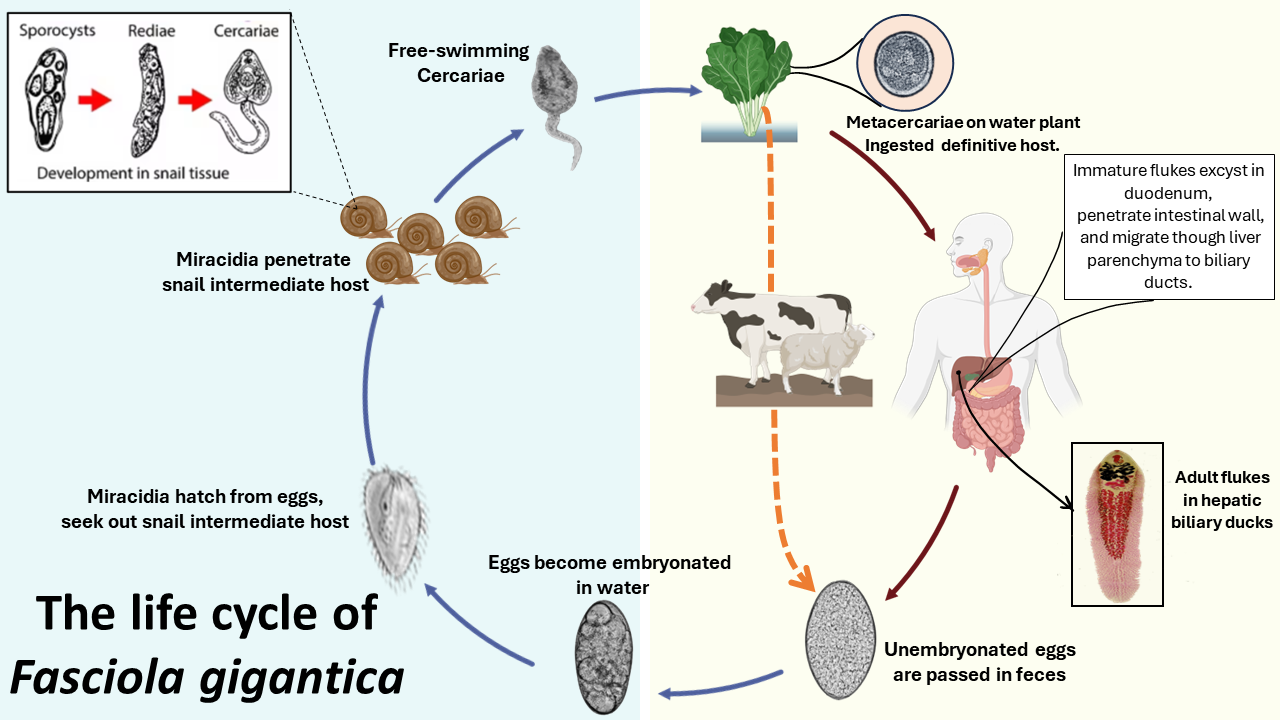
Immature eggs are discharged in the biliary ducts and passed in the stool image. Eggs become embryonated in freshwater over ~2 weeks; embryonated eggs release miracidia, which invade a suitable snail intermediate host. In the snail, the parasites undergo several developmental stages (sporocysts, rediae, and cercariae). The cercariae are released from the snail image and encyst as metacercariae on aquatic vegetation or other substrates. Humans and other mammals become infected by ingesting vegetation contaminated with metacercariae (e.g., watercress). After ingestion, the metacercariae excyst in the duodenum and penetrate through the intestinal wall into the peritoneal cavity. The immature flukes then migrate through the liver parenchyma into biliary ducts, where they mature into adult flukes and produce eggs. In humans, maturation from metacercariae into adult flukes usually takes about 3–4 months; the development of F. gigantica may take longer than that of F. hepatica.
This article was medically reviewed for accuracy by Dr. Zeinab Morshedi Yekta. The content is based on scientific evidence and is intended to be educational. It does not replace professional medical advice.
References
- McMANUS DP, DALTON JP. Vaccines against the zoonotic trematodes Schistosoma japonicum, Fasciola hepatica and Fasciola gigantica. Parasitology. 2006;133(S2):S43-S61. doi:10.1017/S0031182006001806
- Lalor, R., Cwiklinski, K., Calvani, N. E. D., Dorey, A., Hamon, S., Corrales, J. L., … De Marco Verissimo, C. (2021). Pathogenicity and virulence of the liver flukes Fasciola hepatica and Fasciola Gigantica that cause the zoonosis Fasciolosis. Virulence, 12(1), 2839–2867. https://doi.org/10.1080/21505594.2021.1996520
- Raadsma, H. W., Kingsford, N. M., Suharyanta, Spithill, T. W., & Piedrafita, D. (2007). Host responses during experimental infection with Fasciola gigantica or Fasciola hepatica in Merino sheep. Veterinary Parasitology, 143(3–4), 275–286. https://doi.org/10.1016/j.vetpar.2006.09.008